Back

Amphoteric Species quiz

Control buttons has been changed to "navigation" mode.
1/15
  • What is an amphoteric (or amphiprotic) substance?

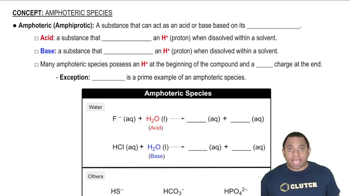
    An amphoteric substance can act as either an acid or a base depending on its environment.
  • How does an acid behave in a solvent according to the transcript?

    An acid donates or gives away an H+ ion (proton) when dissolved in a solvent.
  • What is the behavior of a base in a solvent?

    A base accepts an H+ ion (proton) when dissolved in a solvent.
  • What structural feature is common in many amphoteric species?

    Many amphoteric species have a hydrogen atom at the beginning and a negative charge at the end of their structure.
  • Why is water considered an exception among amphoteric species?

    Water is amphoteric but does not have a hydrogen at the start and a negative charge at the end; it can act as both acid and base.
  • How does water act as an acid in a reaction with fluoride ion?

    Water donates an H+ ion to the fluoride ion, forming HF and leaving behind OH-.
  • What is formed when water donates an H+ ion?

    When water donates an H+ ion, OH- (hydroxide ion) is formed.
  • How does water act as a base in a reaction with hydrochloric acid?

    Water accepts an H+ ion from HCl, forming H3O+ (hydronium ion) and Cl-.
  • What ion is produced when water accepts an H+ ion?

    When water accepts an H+ ion, H3O+ (hydronium ion) is produced.
  • What does H3O+ represent in acid-base chemistry?

    H3O+ represents the hydronium ion, which is formed when water acts as a base and accepts an H+.
  • Are H+ and H3O+ considered interchangeable in aqueous solutions?

    Yes, H+ and H3O+ are often considered synonymous or interchangeable in aqueous solutions.
  • What is a good way to spot amphoteric species based on their structure?

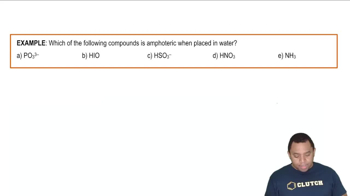
    A good way to spot amphoteric species is to look for a hydrogen at the beginning and a negative charge at the end of their formula.
  • What determines whether an amphoteric species acts as an acid or a base?

    The environment or the other substances present determines whether an amphoteric species acts as an acid or a base.
  • What is the significance of amphoteric behavior in acid-base reactions?

    Amphoteric behavior is essential for understanding proton transfer and acid-base reactions in aqueous solutions.
  • Give an example of an amphoteric species other than water.

    Species with a hydrogen at the start and a negative charge at the end, such as HCO3-, are examples of amphoteric species.