Back

Average Bond Order quiz

Control buttons has been changed to "navigation" mode.
1/15
  • What does average bond order represent in a molecule?

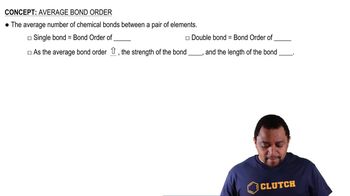
    Average bond order is the average number of chemical bonds between a pair of elements in a molecule.
  • What is the bond order of a single bond?

    A single bond has a bond order of 1.
  • What is the bond order of a double bond?

    A double bond has a bond order of 2.
  • What is the bond order of a triple bond?

    A triple bond has a bond order of 3.
  • How does bond order relate to bond strength?

    Bond strength increases as bond order increases; they are directly proportional.
  • How does bond order relate to bond length?

    Bond length decreases as bond order increases; they are inversely proportional.
  • If a molecule has a higher average bond order, what can you say about its bond strength?

    A higher average bond order means the bonds are stronger.
  • If a molecule has a higher average bond order, what can you say about its bond length?

    A higher average bond order means the bonds are shorter.
  • Why is understanding bond order important in chemistry?

    It helps predict the physical properties and reactivity of molecules.
  • What is the relationship between bond order and the number of chemical bonds?

    Bond order indicates the number of chemical bonds between two atoms.
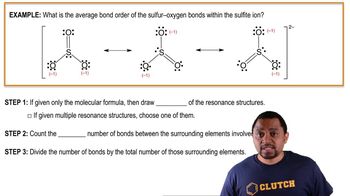
  • How would you calculate the average bond order if a molecule has resonance structures?

    You average the bond orders from all resonance structures between the same pair of atoms.
  • What happens to bond strength if the bond order decreases?

    Bond strength decreases as bond order decreases.
  • What happens to bond length if the bond order decreases?

    Bond length increases as bond order decreases.
  • What is the bond order for a bond that is halfway between a single and double bond?

    The bond order would be 1.5.
  • How does bond order help in predicting molecular reactivity?

    Higher bond order usually means less reactivity due to stronger, shorter bonds.