Back

Beta Decay quiz

Control buttons has been changed to "navigation" mode.
1/15
  • What is a beta particle in the context of beta decay?

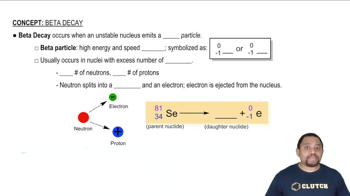
    A beta particle is a high-energy, high-speed electron emitted from an unstable nucleus during beta decay.
  • How is an electron symbolized in nuclear equations for beta decay?

    An electron can be symbolized as e or as a beta particle (β), with a mass number of 0 and an atomic number of -1.
  • Why does beta decay occur in nuclei?

    Beta decay occurs in nuclei with an excess number of neutrons to reduce the neutron count and increase the proton count for greater stability.
  • What happens to a neutron during beta decay?

    A neutron is converted into a proton and an electron; the proton stays in the nucleus, and the electron is ejected.
  • Does the mass number change during beta decay?

    No, the mass number remains the same because the electron's mass is negligible.
  • How does the atomic number change during beta decay?

    The atomic number increases by one because a neutron is converted into a proton.
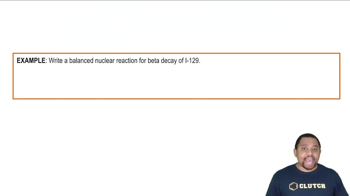
  • What element does selenium-81 become after beta decay?

    Selenium-81 becomes bromine-81 after beta decay, as the atomic number increases from 34 to 35.
  • How do beta particles compare in size to alpha particles?

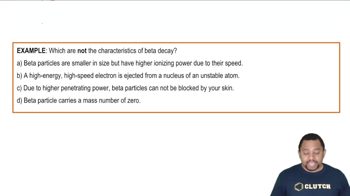
    Beta particles are much smaller than alpha particles, as beta particles are electrons and alpha particles are helium-4 isotopes.
  • Which has higher ionizing power: alpha or beta particles?

    Alpha particles have higher ionizing power than beta particles because they are larger and move more slowly.
  • Why do beta particles have lower ionizing power than alpha particles?

    Beta particles move rapidly through material, giving them less time to ionize surrounding tissue compared to slower-moving alpha particles.
  • Which has higher penetrating power: alpha or beta particles?

    Beta particles have higher penetrating power than alpha particles because they are smaller and move faster.
  • What materials are needed to shield against beta particles?

    Dense materials like metal sheets or thick wood are needed to shield against beta particles due to their high penetrating power.
  • What is the charge of a beta particle?

    A beta particle has a negative charge, represented as -1 in nuclear equations.
  • What stays in the nucleus after beta decay: the proton or the electron?

    The proton stays in the nucleus, while the electron (beta particle) is ejected.
  • How does the size of a particle affect its ionizing and penetrating power?

    Larger particles like alpha particles have higher ionizing power but lower penetrating power, while smaller particles like beta particles have lower ionizing power but higher penetrating power.