Back

Cell Potential and Equilibrium quiz

Control buttons has been changed to "navigation" mode.
1/15
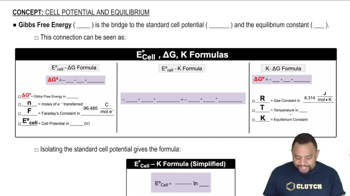
  • What is the equation that relates standard Gibbs free energy (ΔG°) to standard cell potential (E°cell)?

    ΔG° = -nFE°cell, where n is the number of moles of electrons and F is Faraday's constant.
  • What is the value and unit of Faraday's constant (F)?

    Faraday's constant is 96,485 coulombs per mole of electrons (C/mol e-).
  • What does 'n' represent in the equation ΔG° = -nFE°cell?

    'n' is the number of moles of electrons transferred in the redox reaction.
  • What is the equation that relates standard Gibbs free energy (ΔG°) to the equilibrium constant (K)?

    ΔG° = -RTlnK, where R is the gas constant and T is the temperature in Kelvin.
  • What is the value and unit of the gas constant (R) used in ΔG° = -RTlnK?

    The gas constant R is 8.314 joules per mole per Kelvin (J/mol·K).
  • How do you express the relationship between standard cell potential (E°cell) and the equilibrium constant (K)?

    E°cell = (RT/nF) ln K, which connects cell potential to chemical equilibrium.
  • What does the standard cell potential (E°cell) indicate about a redox reaction?

    It indicates the tendency of a redox reaction to occur spontaneously under standard conditions.
  • In what units is the standard cell potential (E°cell) measured?

    Standard cell potential is measured in volts (V).
  • Why can the two equations for ΔG° be set equal to each other?

    Because both equations describe the same thermodynamic quantity, standard Gibbs free energy.
  • What does a positive E°cell value suggest about the spontaneity of a reaction?

    A positive E°cell means the reaction is spontaneous under standard conditions.
  • What does the equilibrium constant (K) represent in the context of redox reactions?

    K represents the ratio of product to reactant concentrations at equilibrium for the redox reaction.
  • How does temperature (T) factor into the relationship between E°cell and K?

    Temperature (in Kelvin) appears in the numerator of the equation E°cell = (RT/nF) ln K, affecting the cell potential.
  • What happens to ΔG° if E°cell is positive?

    ΔG° will be negative, indicating a spontaneous reaction.
  • What is the significance of the equation E°cell = (RT/nF) ln K?

    It shows the direct quantitative relationship between cell potential and the equilibrium constant.
  • How can you isolate E°cell from the equation -nFE°cell = -RTlnK?

    Divide both sides by -nF to get E°cell = (RT/nF) ln K.