Back

Cell Potential: G and K quiz

Control buttons has been changed to "navigation" mode.
1/15
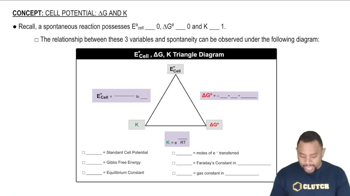
  • What is the condition for a reaction to be spontaneous in terms of standard cell potential (Ecell°)?

    A reaction is spontaneous if the standard cell potential (Ecell°) is greater than zero.
  • What sign must the standard Gibbs free energy change (ΔG°) have for a reaction to be spontaneous?

    ΔG° must be negative for a reaction to be spontaneous.
  • What value must the equilibrium constant (K) have for a reaction to be spontaneous?

    K must be greater than one for a reaction to be spontaneous.
  • What equation relates the standard cell potential (Ecell°) to the equilibrium constant (K)?

    Ecell° = (RT/nF) ln(K), where R is the gas constant, T is temperature, n is moles of electrons, and F is Faraday's constant.
  • What is the equation connecting ΔG° and Ecell°?

    ΔG° = -nFEcell°, where n is moles of electrons and F is Faraday's constant.
  • How are ΔG° and K related mathematically?

    K = e^(-ΔG°/RT), where R is the gas constant and T is temperature in Kelvin.
  • What does the variable 'n' represent in the equations relating Ecell°, ΔG°, and K?

    'n' represents the number of moles of electrons transferred in the reaction.
  • What is the value and unit of Faraday's constant (F)?

    Faraday's constant (F) is 96,485 coulombs per mole of electrons.
  • What is the value and unit of the gas constant (R) used in these equations?

    The gas constant (R) is 8.314 joules per mole per Kelvin (J/mol·K).
  • If Ecell° is negative, what can you say about the spontaneity of the reaction?

    If Ecell° is negative, the reaction is non-spontaneous under standard conditions.
  • If ΔG° is positive, what does this indicate about the reaction?

    A positive ΔG° indicates that the reaction is non-spontaneous.
  • If K is less than 1, what does this say about the direction of the reaction?

    If K is less than 1, the reaction favors the reactants and is non-spontaneous.
  • What does the natural logarithm (ln) of K in the Ecell° equation signify?

    The ln(K) term shows how the equilibrium position affects the cell potential.
  • How can you use these equations to predict the direction of a chemical process?

    By calculating Ecell°, ΔG°, or K, you can determine if a reaction is spontaneous and which direction it will proceed.
  • Why are the relationships between Ecell°, ΔG°, and K important in chemistry?

    They allow us to quantitatively assess reaction spontaneity and predict chemical behavior.