Back

Cell Potential: The Nernst Equation quiz

Control buttons has been changed to "navigation" mode.
1/15
  • What does the reaction quotient (Q) represent in electrochemistry?

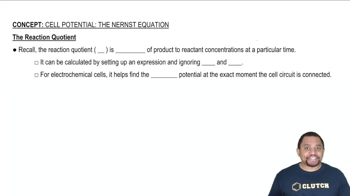
    Q is the ratio of product to reactant concentrations at a specific time, excluding solids and liquids.
  • When is the reaction quotient (Q) used in relation to cell potential?

    Q is used to determine the maximum potential of an electrochemical cell at the moment the circuit is connected.
  • What happens to the voltage of an electrochemical cell over time?

    The voltage decreases as the cell degrades or the battery is used.
  • Under what conditions is the standard cell potential (E°cell) calculated?

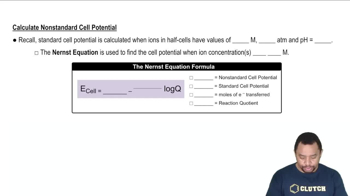
    E°cell is calculated when ion concentrations are 1 molar, pressure is 1 atmosphere, and pH is 7.
  • Why do we use the Nernst equation instead of the standard cell potential equation?

    The Nernst equation is used when ion concentrations are not 1 molar, to calculate nonstandard cell potentials.
  • Write the Nernst equation for cell potential.

    Ecell = E°cell - (0.05916/n) × log(Q).
  • What does 'n' represent in the Nernst equation?

    n is the number of moles of electrons transferred in the redox reaction.
  • What does Ecell represent in the Nernst equation?

    Ecell is the nonstandard cell potential, or the cell potential under nonstandard conditions.
  • What does E°cell represent in the Nernst equation?

    E°cell is the standard cell potential, calculated under standard conditions.
  • Why are solids and liquids ignored in the reaction quotient (Q)?

    Solids and liquids are ignored because their concentrations do not change during the reaction.
  • How does the Nernst equation adjust for nonstandard conditions?

    It modifies the cell potential based on the actual concentrations of ions using the reaction quotient Q.
  • What is the significance of the 0.05916 constant in the Nernst equation?

    0.05916 is a temperature-dependent constant (at 25°C) that relates the cell potential to the reaction quotient.
  • What is the main purpose of the Nernst equation in electrochemistry?

    Its main purpose is to calculate the cell potential when conditions deviate from standard values.
  • How is the reaction quotient (Q) similar to the equilibrium constant (K)?

    Both are ratios of product to reactant concentrations, but Q is at any moment, while K is at equilibrium.
  • What happens to cell potential if Q increases in the Nernst equation?

    If Q increases, the cell potential (Ecell) decreases because the log(Q) term becomes larger.