Back

Complex Ions quiz

Control buttons has been changed to "navigation" mode.
1/15
  • What is the core component of a complex ion?

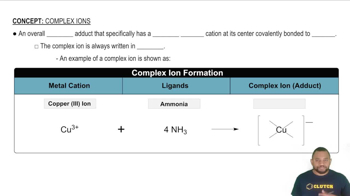
    A transition metal cation is at the center of a complex ion.
  • How are complex ions typically represented in chemical formulas?

    Complex ions are written inside brackets in chemical formulas.
  • What determines the overall charge of a complex ion?

    The overall charge is the sum of the charges of the metal cation and all the ligands.
  • What is a ligand in the context of complex ions?

    A ligand is a molecule or ion covalently bonded to the central metal cation in a complex ion.
  • Why is a complex ion called an 'adduct'?

    It is called an adduct because it results from combining a metal cation with ligands.
  • How can you quickly identify a complex ion in a chemical formula?

    You can identify it by looking for the portion of the formula enclosed in brackets.
  • What is the charge of a complex ion formed by a copper(III) ion and four neutral ammonia ligands?

    The charge is 3+, since copper(III) is 3+ and ammonia ligands are neutral.
  • Do ligands always have a charge in complex ions?

    No, ligands can be neutral or charged, depending on their identity.
  • What type of elements are usually at the center of complex ions in general chemistry?

    Transition metals are usually at the center of complex ions.
  • Can main group elements form complex ions?

    Yes, but they are less common and not typically discussed in general chemistry.
  • What effect do complex ions have on chemical reactions?

    Complex ions can affect the solubility and reactivity of compounds in chemical reactions.
  • What is the significance of understanding the structure and charge of complex ions?

    It helps predict their behavior in chemical processes.
  • What is the relationship between the number of ligands and the structure of a complex ion?

    The number of ligands determines how many molecules or ions are bonded to the central metal cation.
  • What is the charge of ammonia as a ligand in complex ions?

    Ammonia is a neutral ligand, so it contributes no charge.
  • Why is the term 'complex ion' used instead of just 'ion'?

    Because it refers to a charged entity formed by a metal cation and ligands, not just a single atom or simple ion.