Back

Crystal Field Theory: Square Planar Complexes quiz

Control buttons has been changed to "navigation" mode.
1/15
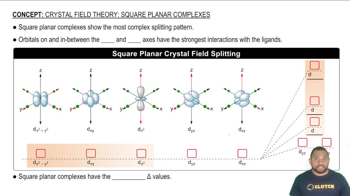
  • Which d-orbital in square planar complexes experiences the strongest interaction with ligands?

    The d(x2-y2) orbital experiences the strongest interaction with ligands in square planar complexes.
  • How does the strength of interaction with ligands affect the energy of d-orbitals in square planar complexes?

    Stronger interactions with ligands result in higher energy for the d-orbitals.
  • What is the order of d-orbital energies in square planar complexes from highest to lowest?

    The order is d(x2-y2), dxy, dz2, dyz, and dxz.
  • Why do d(yz) and d(xz) orbitals have the same energy in square planar complexes?

    They are degenerate because each interacts with only one of the two axes (x or y), resulting in equal energy.
  • What feature of the dz2 orbital allows it to interact with the x and y axes in square planar complexes?

    The dz2 orbital has a ring or disc that lies along and interacts with the x and y axes.
  • Why is the crystal field splitting energy (Δ) particularly large in square planar complexes?

    The strong interactions between certain d-orbitals and ligands create a large energy difference, resulting in a large Δ.
  • Which d-orbital has the second highest energy in square planar complexes?

    The dxy orbital has the second highest energy.
  • How does the shading in the energy diagram relate to orbital-ligand interactions?

    Darker shading indicates stronger interactions and higher energy, while lighter shading indicates weaker interactions and lower energy.
  • What makes the splitting pattern in square planar complexes more complex than in other geometries?

    The varying degrees of interaction with the x and y axes create a gradient of energy levels among the d-orbitals.
  • Which axes are most important for determining d-orbital interactions in square planar complexes?

    The x and y axes are most important for determining these interactions.
  • Why does the d(x2-y2) orbital have the highest energy in square planar complexes?

    It lies directly on the x and y axes, leading to the strongest interaction with ligands.
  • What is meant by 'degenerate' orbitals in the context of square planar complexes?

    Degenerate orbitals have the same energy level due to similar interactions with ligands.
  • How does the interaction of the dxy orbital with ligands compare to that of the d(x2-y2) orbital?

    The dxy orbital interacts with both axes but less strongly than the d(x2-y2) orbital.
  • What visual clue in the energy diagram indicates decreasing interaction strength?

    The shading becomes lighter as interaction strength and energy decrease.
  • Why might the dz2 orbital seem out of place in the energy order, and why is it not?

    It might seem out of place because its main lobes are along the z-axis, but its ring interacts with the x and y axes, justifying its position.