Crystal Field Theory: Square Planar Complexes definitions Flashcards

Crystal Field Theory: Square Planar Complexes definitions
Control buttons has been changed to "navigation" mode.
1/15
  • Square Planar Complexes
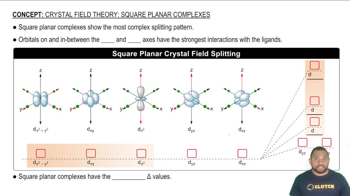
    Coordination compounds with a unique d-orbital splitting pattern due to ligand interactions on the x and y axes.
  • d-Orbitals
    Atomic orbitals involved in bonding, exhibiting different energy levels in square planar complexes.
  • Ligands
    Molecules or ions that interact with metal centers, affecting d-orbital energy levels.
  • X Axis
    One of the axes along which ligands interact strongly with d-orbitals in square planar complexes.
  • Y Axis
    The other axis along which ligands interact strongly with d-orbitals in square planar complexes.
  • d(x2-y2)
    The highest energy d-orbital in square planar complexes, interacting strongly with x and y axes.
  • dxy
    A d-orbital with significant interaction with both x and y axes, having the second highest energy.
  • dz2
    A d-orbital with moderate interaction with x and y axes, forming a disc shape.
  • dyz
    A d-orbital interacting primarily with the y axis, having lower energy in square planar complexes.
  • dxz
    A d-orbital interacting primarily with the x axis, having lower energy in square planar complexes.
  • Crystal Field Splitting
    The energy difference between d-orbitals due to ligand interactions in coordination complexes.
  • Splitting Energy (Δ)
    The energy difference between the highest and lowest d-orbitals in a complex.
  • Degenerate Orbitals
    Orbitals with the same energy level, such as dyz and dxz in square planar complexes.
  • Energy Gradient
    The variation in energy levels of d-orbitals due to differing ligand interactions.
  • Coordination Geometry
    The spatial arrangement of ligands around a central atom in a complex.