Back

Crystal Field Theory Summary quiz

Control buttons has been changed to "navigation" mode.
1/15
  • What does Crystal Field Theory explain in metal complexes?

    It explains the splitting of d-orbitals, which influences the color and magnetic properties of metal complexes.
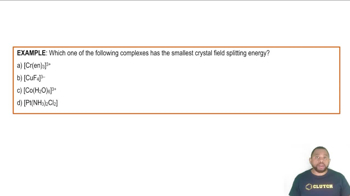
  • Which type of complex has the smallest crystal field splitting energy (Δ)?

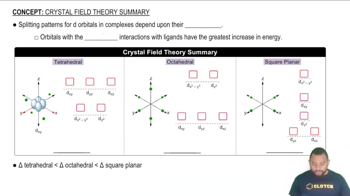
    Tetrahedral complexes have the smallest crystal field splitting energy.
  • In tetrahedral complexes, which d-orbitals are at higher energy?

    The dxy, dyz, and dxz orbitals are at higher energy in tetrahedral complexes.
  • Which d-orbitals are at lower energy in tetrahedral complexes?

    The dx2-y2 and dz2 orbitals are at lower energy in tetrahedral complexes.
  • How does the splitting energy (Δ) of octahedral complexes compare to tetrahedral and square planar complexes?

    Octahedral complexes have an intermediate splitting energy, between tetrahedral (smallest) and square planar (largest).
  • Which d-orbitals are at higher energy in octahedral complexes?

    The dx2-y2 and dz2 orbitals are at higher energy in octahedral complexes.
  • Which d-orbitals are at lower energy in octahedral complexes?

    The dxy, dyz, and dxz orbitals are at lower energy in octahedral complexes.
  • Which complex geometry has the largest crystal field splitting energy (Δ)?

    Square planar complexes have the largest crystal field splitting energy.
  • In square planar complexes, which d-orbital is at the highest energy?

    The dx2-y2 orbital is at the highest energy in square planar complexes.
  • What is the order of d-orbital energies in square planar complexes from highest to lowest?

    The order is dx2-y2 > dxy > dz2 > dyz ≈ dxz.
  • Why do some d-orbitals have higher energy in certain geometries?

    Orbitals with the strongest interactions with ligands experience the greatest increase in energy.
  • In tetrahedral complexes, why are dxy, dyz, and dxz at higher energy?

    Because these orbitals lie between the axes, where ligand interactions are strongest in tetrahedral geometry.
  • In octahedral complexes, why are dx2-y2 and dz2 at higher energy?

    These orbitals lie along the axes, where ligand interactions are strongest in octahedral geometry.
  • What determines whether an octahedral complex has a high or low splitting energy (Δ)?

    It depends on the specific ligands and metal ion involved; more details are covered in advanced topics.
  • How does the splitting pattern in square planar complexes differ from the other geometries?

    Square planar complexes have a more complex splitting pattern, with the dx2-y2 orbital much higher in energy than the others.