Back

De Broglie Wavelength quiz

Control buttons has been changed to "navigation" mode.
1/15
  • What does the de Broglie wavelength connect in terms of an object's properties?

    It connects an object's wave-like behavior to its momentum using Planck's constant.
  • What is the value of Planck's constant used in the de Broglie equation?

    Planck's constant is 6.626 x 10^-34 joule·seconds (J·s).
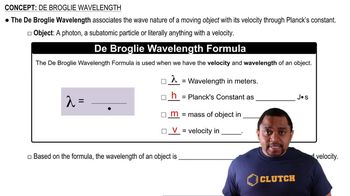
  • Write the de Broglie wavelength equation.

    λ = h / (m*v), where λ is wavelength, h is Planck's constant, m is mass, and v is velocity.
  • How does increasing an object's mass affect its de Broglie wavelength?

    Increasing mass decreases the de Broglie wavelength, since they are inversely proportional.
  • How does increasing an object's velocity affect its de Broglie wavelength?

    Increasing velocity decreases the de Broglie wavelength, as wavelength is inversely proportional to velocity.
  • What does the de Broglie wavelength reveal about matter?

    It reveals the wave-particle duality of matter, especially at the subatomic level.
  • For which types of objects is the de Broglie wavelength most significant?

    It is most significant for subatomic particles like electrons, where wave-like behavior is observable.
  • What units should mass and velocity be in when using the de Broglie equation?

    Mass should be in kilograms (kg) and velocity in meters per second (m/s).
  • What physical phenomenon can be explained using the de Broglie wavelength?

    Electron diffraction and the behavior of particles in potential wells can be explained using the de Broglie wavelength.
  • What symbol is commonly used to represent wavelength in the de Broglie equation?

    The Greek letter lambda (λ) is used to represent wavelength.
  • If an object's velocity is zero, what happens to its de Broglie wavelength?

    If velocity is zero, the de Broglie wavelength is undefined because division by zero is not possible.
  • Why is the de Broglie wavelength usually negligible for macroscopic objects?

    Because their large mass makes the wavelength extremely small, making wave-like behavior unobservable.
  • What is the relationship between momentum and de Broglie wavelength?

    De Broglie wavelength is inversely proportional to momentum (mass times velocity).
  • Can the de Broglie wavelength be applied to photons?

    Yes, it can be applied to photons and any object with velocity.
  • Why is understanding the de Broglie wavelength important in quantum mechanics?

    It is crucial for understanding the wave-particle duality and quantum behavior of particles.