Back

Electrolytic Cell quiz

Control buttons has been changed to "navigation" mode.
1/15
  • What is the main function of an electrolytic cell?

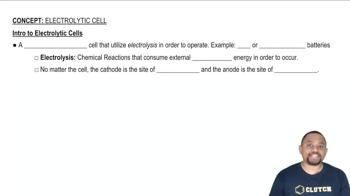
    An electrolytic cell uses external electrical energy to drive non-spontaneous chemical reactions through electrolysis.
  • How does an electrolytic cell differ from a galvanic cell in terms of energy?

    An electrolytic cell consumes electricity to drive reactions, while a galvanic cell generates electricity from spontaneous reactions.
  • What is the charge of the cathode in an electrolytic cell?

    The cathode in an electrolytic cell is negatively charged.
  • What is the charge of the anode in an electrolytic cell?

    The anode in an electrolytic cell is positively charged.
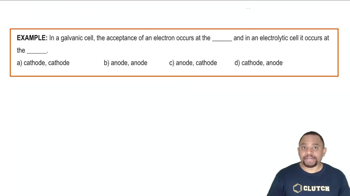
  • Where does reduction always occur in any electrochemical cell?

    Reduction always occurs at the cathode in any electrochemical cell.
  • Where does oxidation always occur in any electrochemical cell?

    Oxidation always occurs at the anode in any electrochemical cell.
  • Why is a battery required in an electrolytic cell?

    A battery is required to supply energy to force electrons to flow against their natural repulsion, driving the non-spontaneous reaction.
  • What is the sign of the standard cell potential (E°cell) for an electrolytic cell?

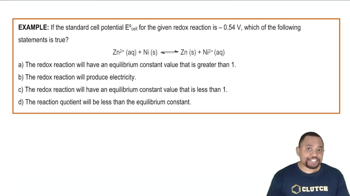
    The standard cell potential for an electrolytic cell is negative.
  • What is the relationship between Gibbs free energy change (ΔG°) and spontaneity in an electrolytic cell?

    For an electrolytic cell, ΔG° is greater than zero, indicating a non-spontaneous reaction.
  • How does the equilibrium constant (K) compare to 1 in an electrolytic cell?

    In an electrolytic cell, the equilibrium constant K is less than 1.
  • What is the relationship between the reaction quotient (Q) and the equilibrium constant (K) in an electrolytic cell?

    In an electrolytic cell, the reaction quotient Q is less than K.
  • What is electrolysis?

    Electrolysis is the process where external electrical energy is used to drive a chemical reaction that would not occur spontaneously.
  • What is a common real-life example of an electrolytic cell?

    Lithium batteries and rechargeable batteries are common examples of electrolytic cells.
  • What role does the salt bridge play in an electrolytic cell?

    The salt bridge allows ions to move between compartments to neutralize charge buildup and maintain electrical neutrality.
  • What happens to copper at the anode in the example given?

    Copper is oxidized at the anode, losing electrons to become copper(II) ions (Cu²⁺).