Skip to main content
General Chemistry
My Course
Learn
Exam Prep
AI Tutor
Study Guides
Textbook Solutions
Flashcards
Explore
Try the app
My Course
Learn
Exam Prep
AI Tutor
Study Guides
Textbook Solutions
Flashcards
Explore
Try the app
Back
Equilibrium Constant Calculations quiz
You can tap to flip the card.
What information do you need to calculate the equilibrium constant (Kc) for a reaction?
You can tap to flip the card.
👆
What information do you need to calculate the equilibrium constant (Kc) for a reaction?
You need the equilibrium concentrations of all reactants and products involved in the reaction.
Track progress
Control buttons has been changed to "navigation" mode.
1/15
Related flashcards
Related practice
Recommended videos
Equilibrium Constant Calculations definitions
Equilibrium Constant Calculations
12 Terms
Equilibrium Constant Calculations
16. Chemical Equilibrium
7 problems
Topic
Jules
Kp and Kc
16. Chemical Equilibrium
6 problems
Topic
Jules
16. Chemical Equilibrium - Part 1 of 2
5 topics
13 problems
Chapter
Jules
16. Chemical Equilibrium - Part 2 of 2
5 topics
13 problems
Chapter
Jules
Guided course
02:38
Equilibrium Constant Calculation
5325
views
80
rank
Terms in this set (15)
Hide definitions
What information do you need to calculate the equilibrium constant (Kc) for a reaction?
You need the equilibrium concentrations of all reactants and products involved in the reaction.
How is the equilibrium constant expression (Kc) written for a reaction involving only gases?
Kc is written as the ratio of the concentrations of products to reactants, each raised to the power of their stoichiometric coefficients.
Which states of matter are excluded from the equilibrium constant expression?
Solids and liquids are excluded from the equilibrium constant expression.
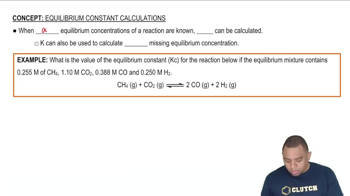
What is the Kc expression for the reaction: CH4(g) + CO2(g) ⇌ 2CO(g) + 2H2(g)?
Kc = [CO]^2[H2]^2 / ([CH4][CO2])
If the equilibrium concentrations are [CH4]=0.255 M, [CO2]=1.10 M, [CO]=0.388 M, and [H2]=0.250 M, how do you set up the Kc calculation?
Plug the values into the expression: Kc = (0.388^2 × 0.250^2) / (0.255 × 1.10).
What is the calculated value of Kc for the given example, before rounding?
The calculated value of Kc before rounding is 0.033543762.
How many significant figures should the final Kc value have in this example?
The final Kc value should have 3 significant figures, matching the given concentrations.
What is the final rounded value of Kc for the example reaction?
The final rounded value of Kc is 0.0335.
Does the equilibrium constant Kc have units in this example?
No, the equilibrium constant Kc is dimensionless in this example.
What does the value of the equilibrium constant Kc represent?
It represents the ratio of product and reactant concentrations at equilibrium.
Can the equilibrium constant be used to find a missing equilibrium concentration?
Yes, if Kc and all but one equilibrium concentration are known, the missing value can be calculated.
Why are the concentrations in the Kc expression raised to a power?
They are raised to the power of their respective stoichiometric coefficients from the balanced equation.
What should you do if the equilibrium constant calculation gives a long decimal?
You should round the answer to the correct number of significant figures based on the data provided.
Why are all species included in the Kc expression for the given example?
All species are gases, and only gases and aqueous species are included in Kc expressions.
What fundamental concept in chemical thermodynamics does the equilibrium constant illustrate?
It illustrates the relationship between the concentrations of products and reactants at equilibrium.
 BackBack
 02:38
02:38