Skip to main content
General Chemistry
My Course
Learn
Exam Prep
AI Tutor
Study Guides
Textbook Solutions
Flashcards
Explore
Try the app
My Course
Learn
Exam Prep
AI Tutor
Study Guides
Textbook Solutions
Flashcards
Explore
Try the app
Back
ICE Charts quiz
You can tap to flip the card.
What does ICE stand for in ICE charts?
You can tap to flip the card.
👆
What does ICE stand for in ICE charts?
ICE stands for Initial, Change, and Equilibrium.
Track progress
Control buttons has been changed to "navigation" mode.
1/15
Related flashcards
Related practice
Recommended videos
ICE Charts definitions
ICE Charts
11 Terms
ICE Charts
16. Chemical Equilibrium
7 problems
Topic
Jules
Reaction Quotient
16. Chemical Equilibrium
5 problems
Topic
Jules
16. Chemical Equilibrium - Part 1 of 2
5 topics
13 problems
Chapter
Jules
16. Chemical Equilibrium - Part 2 of 2
5 topics
13 problems
Chapter
Jules
Guided course
08:03
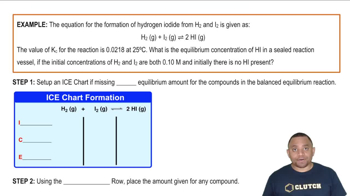
Calculate Equilibrium Amount with ICE Chart Example
5587
views
66
rank
3
comments
Guided course
00:39
ICE Charts and Equilibrium Constant
3871
views
23
rank
Guided course
01:14
ICE Charts and Equilibrium Amount
5132
views
51
rank
Terms in this set (15)
Hide definitions
What does ICE stand for in ICE charts?
ICE stands for Initial, Change, and Equilibrium.
When are ICE charts typically used in equilibrium reactions?
ICE charts are used when more than one equilibrium amount for compounds in a balanced reaction is unknown.
What are the two possible units used in ICE charts?
The units are either atmospheres (for Kp) or molarity (for Kc).
What is the main purpose of using an ICE chart?
The main purpose is to simplify and organize calculations for equilibrium reactions.
How do ICE charts help with calculating the equilibrium constant K?
They organize data to determine the ratio of product to reactant concentrations at equilibrium, which is K.
What does the equilibrium constant K represent?
K is the ratio of product to reactant amounts at equilibrium.
Can ICE charts be used if only one equilibrium amount is given?
Yes, ICE charts can help solve for the equilibrium constant K even if only one equilibrium amount is provided.
Why is it important to use the correct units in ICE charts?
The correct units (atmospheres or molarity) are needed because Kp and Kc require specific units for accurate calculations.
What type of chemical reactions are ICE charts used for?
ICE charts are used for balanced chemical equilibrium reactions.
What does the 'Initial' row in an ICE chart represent?
It represents the starting amounts or concentrations of reactants and products before any reaction occurs.
What does the 'Change' row in an ICE chart indicate?
It shows the amount by which reactant and product concentrations change as the system moves toward equilibrium.
What does the 'Equilibrium' row in an ICE chart show?
It displays the final concentrations or amounts of all species once equilibrium is reached.
How do ICE charts help with complex equilibrium equations?
They organize information, making it easier to solve for unknowns in complicated equilibrium problems.
What should you do before using an ICE chart for a reaction?
Ensure the reaction is balanced and identify which equilibrium amounts are missing.
Why are ICE charts considered essential tools in chemistry?
They simplify the process of understanding and calculating chemical equilibria, especially when multiple unknowns are involved.
 BackBack
 08:03
08:03