Back

Isomerism in Coordination Complexes quiz

Control buttons has been changed to "navigation" mode.
1/15
  • What is an isomer in the context of coordination complexes?

    An isomer is a molecule with the same molecular formula as another but differs in connectivity or spatial orientation.
  • How do structural isomers differ from stereoisomers in coordination complexes?

    Structural isomers have different connections between atoms, while stereoisomers have the same connections but differ in spatial arrangement.
  • What is a coordination isomer?

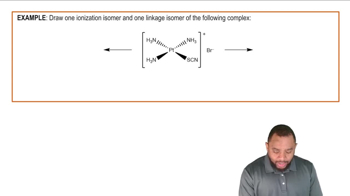
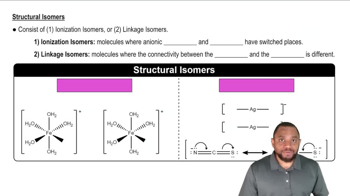
    A coordination isomer occurs when an anionic ligand and a counter ion switch places in a coordination complex.
  • What is a linkage isomer?

    A linkage isomer arises when the connectivity between the ligand and the metal changes, such as when different donor atoms in a ligand bind to the metal.
  • How can swapping a bromine and chlorine in a complex create a structural isomer?

    Swapping a bromine and chlorine changes which atom is connected to the metal, resulting in a different connectivity but the same overall formula.
  • What distinguishes geometric isomers in coordination complexes?

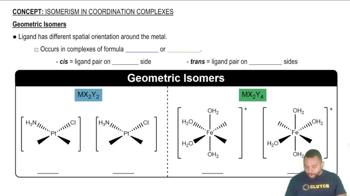
    Geometric isomers differ in the spatial orientation of ligands around the metal, such as cis (same side) and trans (opposite sides) arrangements.
  • In which types of complexes do geometric isomers commonly occur?

    Geometric isomers commonly occur in complexes with formulas like MX2Y2 and MX2Y4.
  • What does 'cis' mean in the context of geometric isomers?

    Cis means that a pair of identical ligands are on the same side of the metal center.
  • What does 'trans' mean in the context of geometric isomers?

    Trans means that a pair of identical ligands are on opposite sides of the metal center.
  • How does resonance in ligands like thiocyanate lead to linkage isomerism?

    Resonance allows multiple atoms (such as nitrogen or sulfur) to act as donor atoms, resulting in different connectivity to the metal and thus linkage isomers.
  • What must be true about the charges when creating coordination isomers?

    The charges of the anionic ligand and the counter ion must be the same when they switch places.
  • What is the role of donor atoms in linkage isomerism?

    Donor atoms are the negatively charged atoms within a ligand that bind to the metal, and different donor atoms can create linkage isomers.
  • How can you create a cis isomer in an MX2Y2 complex?

    Place both X ligands (e.g., ammonia) and both Y ligands (e.g., chloride) on the same side of the metal center.
  • How can you create a trans isomer in an MX2Y2 complex?

    Place the X ligands and Y ligands on opposite sides of the metal center.
  • What are the two main types of structural isomers in coordination chemistry?

    The two main types are coordination isomers and linkage isomers.