Back

Isomers quiz

Control buttons has been changed to "navigation" mode.
1/15
  • What is the definition of isomers in chemistry?

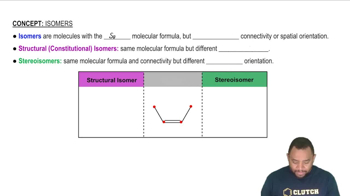
    Isomers are molecules with the same molecular formula but different connectivity or spatial orientation.
  • How do structural (constitutional) isomers differ from each other?

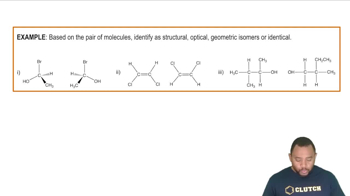
    They have the same molecular formula but different connectivity of their atoms.
  • What distinguishes stereoisomers from structural isomers?

    Stereoisomers have the same molecular formula and connectivity but differ in the spatial arrangement of their atoms.
  • What are the two main types of stereoisomers?

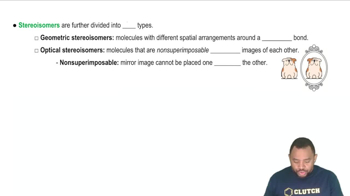
    The two main types are geometric (cis/trans) isomers and optical isomers.
  • How can you identify geometric isomers in a molecule?

    Geometric isomers differ in the spatial arrangement of groups around a double bond, such as cis (same side) and trans (opposite sides).
  • What is a simple way to distinguish optical isomers?

    Optical isomers are non-superimposable mirror images of each other, like left and right hands.
  • What does 'non-superimposable' mean in the context of optical isomers?

    It means the mirror images cannot be placed on top of each other to match perfectly.
  • Give an example of a molecular formula that can have structural isomers.

    C4H8 can have structural isomers with different carbon chain arrangements.
  • How can you create a structural isomer from a straight-chain molecule?

    By rearranging the connectivity, such as making a branch off the main chain.
  • What is the difference between cis and trans geometric isomers?

    Cis isomers have substituent groups on the same side of a double bond, while trans isomers have them on opposite sides.
  • How can you use a mirror to identify optical isomers?

    If a molecule and its mirror image cannot be superimposed, they are optical isomers.
  • What is an alternative to using a mirror for drawing optical isomers?

    Invert the bonds that show spatial orientation, such as changing dashed to solid wedges and vice versa.
  • Why is understanding isomers important in chemistry?

    Because isomers have the same molecular formula but can have vastly different properties due to their structural or spatial differences.
  • What is the key feature that all isomers share?

    All isomers share the same molecular formula.
  • How do you determine if two molecules are structural isomers?

    Check if they have the same molecular formula but different connectivity of atoms.