Skip to main content
General Chemistry
My Course
Learn
Exam Prep
AI Tutor
Study Guides
Textbook Solutions
Flashcards
Explore
Try the app
My Course
Learn
Exam Prep
AI Tutor
Study Guides
Textbook Solutions
Flashcards
Explore
Try the app
Back
Le Chatelier's Principle quiz
You can tap to flip the card.
What does Le Chatelier's principle state about a reaction at equilibrium when it is disturbed?
You can tap to flip the card.
👆
What does Le Chatelier's principle state about a reaction at equilibrium when it is disturbed?
It states that the reaction will shift in a direction that minimizes the disturbance and reestablishes equilibrium.
Track progress
Control buttons has been changed to "navigation" mode.
1/15
Related flashcards
Related practice
Recommended videos
Le Chatelier's Principle definitions
Le Chatelier's Principle
15 Terms
Le Chatelier's Principle
16. Chemical Equilibrium
7 problems
Topic
Jules
ICE Charts
16. Chemical Equilibrium
7 problems
Topic
Jules
16. Chemical Equilibrium - Part 1 of 2
5 topics
13 problems
Chapter
Jules
16. Chemical Equilibrium - Part 2 of 2
5 topics
13 problems
Chapter
Jules
Guided course
04:04
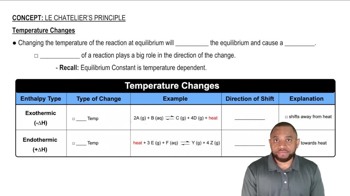
Temperature and Equilibrium Shifts
4096
views
43
rank
1
comments
Guided course
07:32
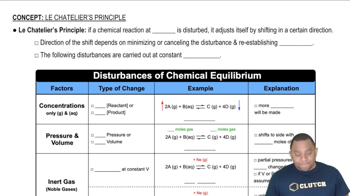
Le Chatelier's Principle
5833
views
55
rank
Guided course
02:50
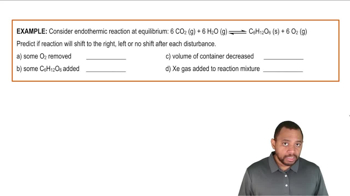
Disturbances and Equilibrium Shifts Example
3921
views
39
rank
Terms in this set (15)
Hide definitions
What does Le Chatelier's principle state about a reaction at equilibrium when it is disturbed?
It states that the reaction will shift in a direction that minimizes the disturbance and reestablishes equilibrium.
How does increasing the concentration of reactants affect the direction of the equilibrium shift?
The reaction shifts forward, converting excess reactants into products to restore equilibrium.
What happens to the equilibrium if you decrease the concentration of products?
The reaction shifts forward to produce more products and reestablish equilibrium.
If you increase the pressure of a reaction mixture, towards which side does the equilibrium shift?
It shifts towards the side with fewer moles of gas.
What is the effect of decreasing the volume of a reaction vessel on the equilibrium position?
Decreasing volume increases pressure, causing the equilibrium to shift to the side with fewer moles of gas.
How does adding an inert gas at constant volume affect the equilibrium?
It causes no shift in the equilibrium position because partial pressures of the reacting gases do not change.
What happens if an inert gas is added at constant pressure?
The equilibrium shifts toward the side with more moles of gas because the volume increases.
Does adding a catalyst affect the position of equilibrium?
No, a catalyst only speeds up the rate at which equilibrium is reached but does not affect the equilibrium position.
If you decrease the concentration of reactants, what direction does the equilibrium shift?
The equilibrium shifts toward the reactants to produce more reactants.
How does increasing the concentration of products affect the equilibrium?
The reaction shifts toward the reactants to reduce the excess products.
What is the effect of decreasing pressure on the equilibrium position?
The equilibrium shifts toward the side with more moles of gas.
How does increasing temperature affect an exothermic reaction at equilibrium?
The equilibrium shifts away from the sopurce of heat, toward the reactants (left side).
In an endothermic reaction, what happens if the temperature is decreased?
The equilibrium shifts toward the heat, which is on the reactant side, to absorb more heat.
Why is it important to know if a reaction is endothermic or exothermic when considering temperature changes?
Because it tells you which side heat is on, which determines the direction of the equilibrium shift when temperature changes.
How does changing temperature affect the equilibrium constant (K)?
Changing temperature alters the value of the equilibrium constant, affecting the direction and extent of the equilibrium shift.
 BackBack
 04:04
04:04