Back

Ligands quiz

Control buttons has been changed to "navigation" mode.
1/15
  • What is a ligand in the context of coordination chemistry?

    A ligand is a molecule or ion that acts as a Lewis base and donates at least one lone pair to a metal cation.
  • How does a metal cation behave when interacting with a ligand?

    A metal cation acts as a Lewis acid by accepting a lone pair from the ligand.
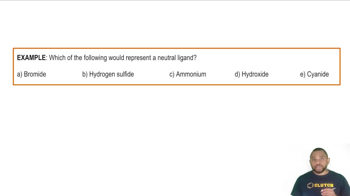
  • What is the difference between neutral and anionic ligands?

    Neutral ligands have no overall charge, while anionic ligands carry a negative charge.
  • Give two examples of neutral ligands.

    Examples of neutral ligands include ammonia (NH3) and water (H2O).
  • Name two examples of anionic ligands.

    Examples of anionic ligands are hydroxide ion (OH-) and cyanide ion (CN-).
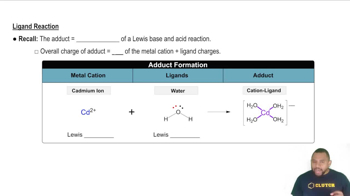
  • What is an adduct in ligand chemistry?

    An adduct is the product formed when ligands bind to a metal cation, combining a Lewis base and a Lewis acid.
  • How is the overall charge of an adduct determined?

    The overall charge of an adduct is the sum of the charges of the metal cation and the ligands.
  • In the complex [Cd(H2O)4]2+, what is the charge on the cadmium ion and on the water ligands?

    The cadmium ion has a 2+ charge, and each water ligand is neutral with a charge of 0.
  • Why is ammonia considered a ligand?

    Ammonia is a ligand because it has a lone pair that can be donated to a metal cation.
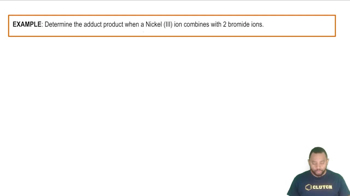
  • What group of elements do halide ligands (X-) come from?

    Halide ligands come from group 7A elements, such as fluorine, chlorine, bromine, and iodine.
  • Which atom in the cyanide ion donates the lone pair to the metal cation?

    The carbon atom in the cyanide ion donates the lone pair to the metal cation.
  • What is the role of a Lewis base in ligand chemistry?

    A Lewis base donates an electron pair to a metal cation, forming a coordinate bond.
  • Can ligands be positively charged in general chemistry?

    No, in general chemistry, ligands are typically neutral or negatively charged, not positively charged.
  • How many water molecules are attached to cadmium in the [Cd(H2O)4]2+ adduct?

    There are four water molecules attached to the cadmium ion in the [Cd(H2O)4]2+ adduct.
  • What is the overall charge of the adduct formed by Cd2+ and four water molecules?

    The overall charge is 2+, which is the charge of the cadmium ion since water is neutral.