General Chemistry
My Course
Learn
Exam Prep
AI Tutor
Study Guides
Textbook Solutions
Flashcards
Explore
My Course
Learn
Exam Prep
AI Tutor
Study Guides
Textbook Solutions
Flashcards
Explore
Back
Main Group Elements: Periodic Trends quiz
You can tap to flip the card.
Define:
Which periodic trends increase as you move toward the top right corner of the periodic table?
You can tap to flip the card.
👆
Which periodic trends increase as you move toward the top right corner of the periodic table?
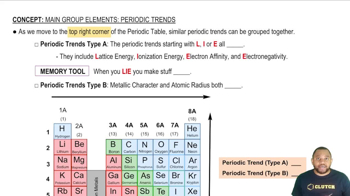
Lattice energy, ionization energy, electron affinity, and electronegativity all increase toward the top right corner.
Track progress
Control buttons has been changed to "navigation" mode.
1/15
Related flashcards
Related practice
Recommended videos
Main Group Elements: Periodic Trends definitions
Main Group Elements: Periodic Trends
10 Terms
Main Group Elements: Periodic Trends
23. Chemistry of the Nonmetals
5 problems
Topic

Jules
23. Chemistry of the Nonmetals - Part 1 of 2
5 topics
12 problems
Chapter
Jules
23. Chemistry of the Nonmetals - Part 2 of 2
6 topics
11 problems
Chapter
Jules
Guided course
01:55
Periodic Trends
Jules Bruno
919
views
Guided course
00:59
Main Group Elements: Periodic Trends Example
Jules Bruno
806
views
Terms in this set (15)
Hide definitions
Which periodic trends increase as you move toward the top right corner of the periodic table?
Lattice energy, ionization energy, electron affinity, and electronegativity all increase toward the top right corner.
What is a helpful mnemonic for remembering which periodic trends increase toward the top right?
The mnemonic is 'LIE' for Lattice energy, Ionization energy, and Electron affinity/Electronegativity.
Which periodic trends decrease as you move toward the top right corner of the periodic table?
Atomic radius and metallic character decrease toward the top right corner.
How do atomic radius and metallic character change across a period from left to right?
Both atomic radius and metallic character decrease as you move from left to right across a period.
What happens to ionization energy as you move up and to the right on the periodic table?
Ionization energy increases as you move up and to the right.
How does electron affinity trend across the periodic table?
Electron affinity increases as you move toward the top right corner.
What is the trend for electronegativity among main group elements?
Electronegativity increases as you move toward the top right corner of the periodic table.
How does lattice energy change as you move toward the top right of the periodic table?
Lattice energy increases as you move toward the top right.
Why are periodic trends grouped into Type A and Type B?
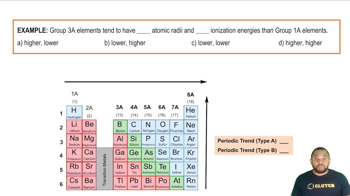
They are grouped because Type A trends (LIE) increase toward the top right, while Type B trends (atomic radius and metallic character) decrease.
What does the mnemonic 'when you lie, you make stuff up' refer to in periodic trends?
It refers to the fact that Lattice energy, Ionization energy, Electron affinity, and Electronegativity all increase (go up) toward the top right.
If a periodic trend is not increasing toward the top right, what is it likely doing?
It is likely decreasing toward the top right.
Which two periodic trends are classified as Type B?
Atomic radius and metallic character are Type B trends.
What should you do if you are unsure about ionization energy or electron affinity?
You should review earlier chapters or videos for more details, as these topics can be complex.
How do the periodic trends reflect the increasing nonmetallic properties of elements?
As you move toward the top right, increasing ionization energy, electron affinity, and electronegativity indicate more nonmetallic character.
What general direction on the periodic table do most nonmetallic properties increase?
Nonmetallic properties increase as you move toward the top right corner of the periodic table.