Skip to main content
General Chemistry
My Course
Learn
Exam Prep
AI Tutor
Study Guides
Textbook Solutions
Flashcards
Explore
Try the app
My Course
Learn
Exam Prep
AI Tutor
Study Guides
Textbook Solutions
Flashcards
Explore
Try the app
Back
Multiplication and Division Operations quiz
You can tap to flip the card.
When multiplying numbers in scientific notation, what do you do with the coefficients and exponents?
You can tap to flip the card.
👆
When multiplying numbers in scientific notation, what do you do with the coefficients and exponents?
Multiply the coefficients and add the exponents.
Track progress
Control buttons has been changed to "navigation" mode.
1/15
Related flashcards
Related practice
Recommended videos
Multiplication and Division Operations definitions
Multiplication and Division Operations
10 Terms
Multiplication and Division Operations quiz #1
Multiplication and Division Operations
10 Terms
Multiplication and Division Operations
5. BONUS: Mathematical Operations and Functions
10 problems
Topic
Addition and Subtraction Operations
5. BONUS: Mathematical Operations and Functions
10 problems
Topic
5. BONUS: Mathematical Operations and Functions
5 topics
15 problems
Chapter
Guided course
02:34
Scientific Notation Multiplication
3907
views
9
rank
1
comments
Guided course
02:10
Scientific Notation in Multiplication and Division
4445
views
10
rank
Guided course
03:10
Scientific Notation Mixed Operations
3625
views
12
rank
1
comments
Terms in this set (15)
Hide definitions
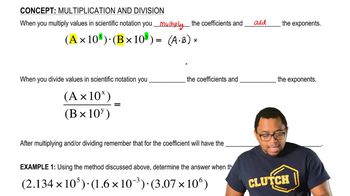
When multiplying numbers in scientific notation, what do you do with the coefficients and exponents?
Multiply the coefficients and add the exponents.
How do you handle the coefficients and exponents when dividing numbers in scientific notation?
Divide the coefficients and subtract the exponents.
What is the correct scientific notation form for the coefficient?
The coefficient must be a number between 1 and less than 10.
After performing multiplication or division, how do you determine the number of significant figures in your answer?
Use the least number of significant figures from the coefficients used in the calculation.
What should you do if your coefficient after calculation is not between 1 and 10?
Adjust the decimal point and change the exponent accordingly to ensure the coefficient is between 1 and 10.
When multiplying (A × 10^x) × (B × 10^y), what is the resulting exponent?
The resulting exponent is x + y.
When dividing (A × 10^x) ÷ (B × 10^y), what is the resulting exponent?
The resulting exponent is x - y.
If you multiply 2.13 × 10^5, 1.66 × 10^-3, and 3.07 × 10^6, what do you do with the exponents?
Add the exponents: 5 + (-3) + 6 = 8.
How do you count significant figures in a coefficient with a decimal?
Start counting from the first nonzero digit and count all digits to the end.
If your calculated coefficient is 10.4822, how do you write it in proper scientific notation with 2 significant figures?
Write it as 1.0 × 10^1, adjusting the exponent to keep the coefficient between 1 and 10.
What happens to the exponent if you make the coefficient smaller to fit scientific notation?
The exponent increases by the number of places you move the decimal to the left.
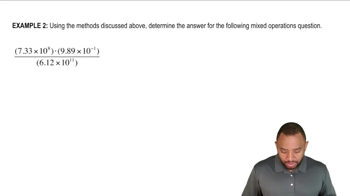
When performing mixed operations (multiplication and division), how do you handle the exponents?
Add exponents for multiplication and subtract exponents for division.
If all coefficients in a calculation have 3 significant figures, how many should your final answer have?
The final answer should have 3 significant figures.
Why is it important to use parentheses when entering scientific notation into a calculator?
Parentheses ensure the calculator interprets the numbers correctly and gives the right answer.
What is the rule for significant figures when adding or subtracting numbers (not multiplying or dividing)?
Use the least number of decimal places from the numbers involved.
 BackBack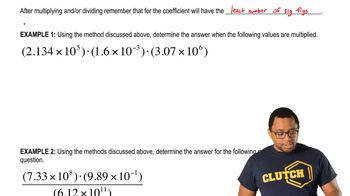
 02:34
02:34