Back

Naming Alcohols quiz

Control buttons has been changed to "navigation" mode.
1/15
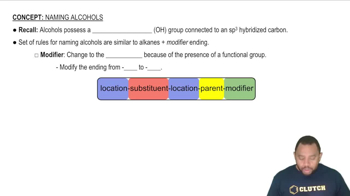
  • What functional group characterizes alcohols?

    Alcohols are characterized by the presence of a hydroxyl (OH) group.
  • To what type of carbon is the hydroxyl group attached in alcohols?

    The hydroxyl group is attached to an sp3 hybridized carbon.
  • How is the suffix of an alkane modified when naming an alcohol?

    The suffix changes from 'e' to 'ol' to indicate the presence of an alcohol group.
  • What is the modifier in alcohol nomenclature?

    The modifier is the change in the suffix of the parent alkane name due to the functional group, specifically from 'e' to 'ol' for alcohols.
  • How would you name an alcohol derived from pentane?

    Pentane becomes pentanol when an alcohol group is present.
  • Why is it important to indicate the location of the hydroxyl group in alcohols?

    Indicating the location ensures a clear and accurate representation of the alcohol's chemical identity.
  • What else, besides the hydroxyl group, must be indicated in the name of an alcohol?

    The locations of any substituents (branch groups) must also be indicated.
  • What does the suffix 'ol' in a compound's name signify?

    The suffix 'ol' signifies the presence of an alcohol (hydroxyl) group.
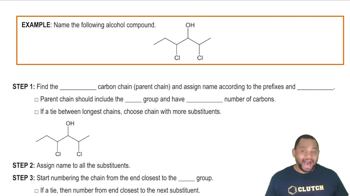
  • What is the parent chain in alcohol nomenclature?

    The parent chain is the longest continuous chain containing the hydroxyl group.
  • How do you choose the parent chain when naming an alcohol?

    Choose the longest chain that includes the carbon bonded to the hydroxyl group.
  • What is the first step in naming an alcohol?

    Identify the longest carbon chain containing the hydroxyl group.
  • How are substituents indicated in the name of an alcohol?

    Substituents are indicated by their position numbers and names as prefixes.
  • What is the general formula for naming a simple alcohol?

    The general formula is alkane name with the 'e' replaced by 'ol', and the position of the OH group indicated.
  • Why do naming conventions for alcohols adapt those of alkanes?

    They adapt alkane conventions to systematically indicate the presence and position of the hydroxyl group.
  • What is the significance of systematic naming in organic chemistry?

    Systematic naming ensures clear communication and accurate identification of chemical structures.