Back

Naming Benzene quiz

Control buttons has been changed to "navigation" mode.
1/15
  • What is a monosubstituted benzene compound?

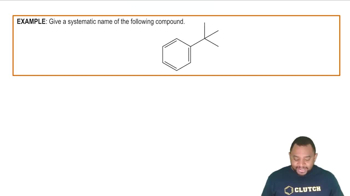
    A monosubstituted benzene has the benzene ring as the parent chain with only one substituent attached. The location of the substituent does not need to be specified.
  • How do you name a monosubstituted benzene compound?

    Name the substituent first, followed by 'benzene' as the parent chain. For example, 'chlorobenzene' for a benzene ring with a chlorine substituent.
  • Why is the location of the substituent not specified in monosubstituted benzenes?

    Because there is only one substituent, its position is always assumed to be on the benzene ring, making location specification unnecessary.
  • What is a disubstituted benzene compound?

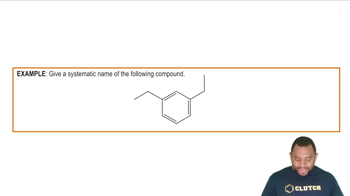
    A disubstituted benzene has two substituents attached to the benzene ring, which requires specifying their locations.
  • How are substituents numbered in disubstituted benzene compounds?

    Substituents are numbered in alphabetical order, starting with the substituent whose name comes first alphabetically.
  • What are the three special terms used to describe the positions of substituents in disubstituted benzenes?

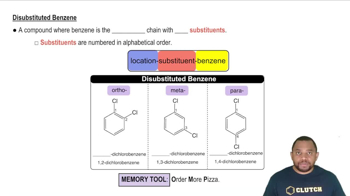
    The terms are ortho (1,2), meta (1,3), and para (1,4), which indicate the relative positions of the substituents on the benzene ring.
  • What does 'ortho' mean in benzene nomenclature?

    'Ortho' refers to substituents located at positions 1 and 2 on the benzene ring.
  • What does 'meta' mean in benzene nomenclature?

    'Meta' refers to substituents located at positions 1 and 3 on the benzene ring.
  • What does 'para' mean in benzene nomenclature?

    'Para' refers to substituents located at positions 1 and 4 on the benzene ring.
  • How can you remember the order of ortho, meta, and para positions?

    Use the mnemonic 'Order More Pizza' to remember ortho (1,2), meta (1,3), and para (1,4) positions.
  • Can ortho, meta, and para naming be used for different substituents?

    Yes, the ortho, meta, and para system applies whether the substituents are identical or different.
  • What is the alternative to using ortho, meta, and para for naming disubstituted benzenes?

    You can use numerical positions, such as 1,2-dichlorobenzene, 1,3-dichlorobenzene, or 1,4-dichlorobenzene.
  • How would you name a benzene ring with chlorine atoms at positions 1 and 2?

    It can be named as 1,2-dichlorobenzene or ortho-dichlorobenzene.
  • How would you name a benzene ring with chlorine atoms at positions 1 and 3?

    It can be named as 1,3-dichlorobenzene or meta-dichlorobenzene.
  • How would you name a benzene ring with chlorine atoms at positions 1 and 4?

    It can be named as 1,4-dichlorobenzene or para-dichlorobenzene.