Back

Photoelectric Effect quiz

Control buttons has been changed to "navigation" mode.
1/15
  • What is the photoelectric effect as described by Einstein?

    The photoelectric effect occurs when photons with enough energy strike a metal surface and eject electrons from it.
  • What must the energy of a photon exceed to eject an electron from a metal surface?

    The photon’s energy must exceed the metal’s binding energy (BE), also known as the work function or threshold frequency.
  • What happens to any excess energy from the photon after an electron is ejected?

    Any excess energy is converted into the kinetic energy (KE) of the ejected electron.
  • What is the formula for the photoelectric effect?

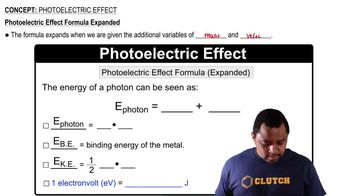
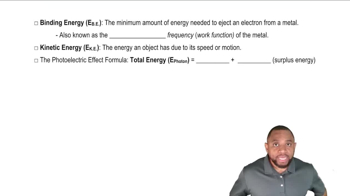
    The formula is: Energy of photon (Ephoton) = Binding energy (BE) + Kinetic energy (KE).
  • What is binding energy (BE) in the context of the photoelectric effect?

    Binding energy is the minimum energy required to eject an electron from a metal surface.
  • What are other names for binding energy in the photoelectric effect?

    Binding energy is also called threshold frequency or work function.
  • How is kinetic energy (KE) defined in the photoelectric effect?

    Kinetic energy is the energy an electron has due to its motion after being ejected.
  • What is the equation for kinetic energy when mass and velocity are given?

    Kinetic energy (KE) = 1/2 × mass × velocity squared (KE = 1/2 m v^2).
  • What is the relationship between photon energy, binding energy, and kinetic energy?

    Photon energy equals the sum of binding energy and kinetic energy: Ephoton = BE + KE.
  • What is Planck’s constant used for in the photoelectric effect?

    Planck’s constant (h) is used to calculate photon energy as h times frequency (Ephoton = hν).
  • What unit is commonly used to measure energy in the photoelectric effect besides joules?

    Energy is often measured in electron volts (eV) in addition to joules.
  • How many joules are in one electron volt (eV)?

    One electron volt equals 1.602 × 10^-19 joules.
  • What should you do if energy is given in electron volts but you need it in joules?

    Use the conversion factor 1 eV = 1.602 × 10^-19 joules to convert the units.
  • What happens if the photon’s energy is less than the binding energy of the metal?

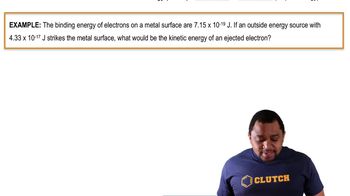
    No electron will be ejected; the electron remains bound to the metal surface.
  • Why is understanding the photoelectric effect important in chemistry?

    It is crucial for understanding quantum mechanics and the behavior of light and electrons.