Back

Pressure Units quiz

Control buttons has been changed to "navigation" mode.
1/15
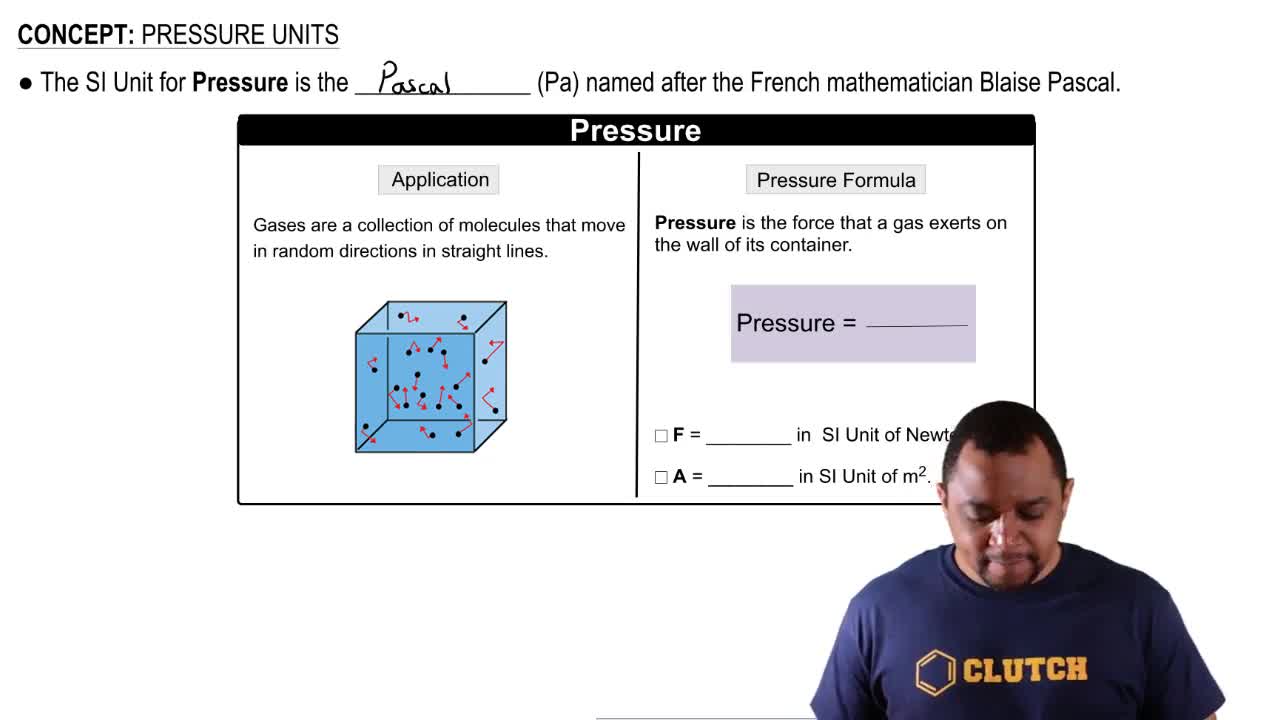
  • What is the SI unit for pressure and after whom is it named?

    The SI unit for pressure is the pascal (Pa), named after Blaise Pascal.
  • How is pressure defined in terms of force and area?

    Pressure is defined as the force exerted per unit area, or pressure = force/area.
  • What is the SI unit for force and for area when calculating pressure?

    The SI unit for force is the newton (N), and for area it is meters squared (m²).
  • What is the behavior of gas molecules inside a container?

    Gas molecules move randomly in straight lines, bouncing off the walls of the container and each other.
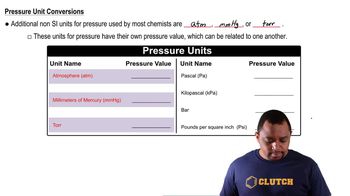
  • What is the value of 1 atmosphere (atm) in millimeters of mercury (mmHg)?

    1 atmosphere (atm) is equal to 760 millimeters of mercury (mmHg).
  • What is the value of 1 atmosphere (atm) in torr?

    1 atmosphere (atm) is equal to 760 torr.
  • Which three non-SI units for pressure are most commonly used by chemists?

    Atmospheres (atm), millimeters of mercury (mmHg), and torr are the most commonly used non-SI units.
  • What is the value of 1 atmosphere (atm) in pascals (Pa)?

    1 atmosphere (atm) is equal to 1.01325 × 10⁵ pascals (Pa).
  • What is the value of 1 atmosphere (atm) in bars?

    1 atmosphere (atm) is equal to 1.01325 bars.
  • What is the value of 1 atmosphere (atm) in pounds per square inch (psi)?

    1 atmosphere (atm) is equal to 14.696 psi.
  • Which pressure unit is abbreviated as 'Pa'?

    The pascal is abbreviated as 'Pa'.
  • Why is it important to memorize the relationships between atm, mmHg, and torr?

    These relationships are commonly used in chemistry and are often required for quizzes and exams.
  • Are the conversion values for pascals, kilopascals, bars, and psi usually given on exams?

    Yes, these values are typically provided on formula sheets or within the question.
  • What does the equation pressure = force/area mean in the context of gases?

    It means that the pressure a gas exerts is the result of the force of its molecules hitting the container walls divided by the area of those walls.
  • What does 'kilo' mean in the context of kilopascals (kPa)?

    'Kilo' means 1,000, so 1 kPa is 1,000 pascals.