Back

Quantum Numbers: Angular Momentum Quantum Number quiz

Control buttons has been changed to "navigation" mode.
1/15
  • What does the angular momentum quantum number (l) determine in an atom?

    It determines the shape of the atom's orbitals.
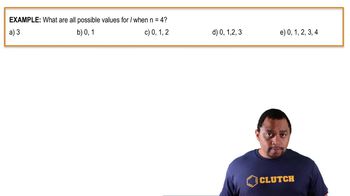
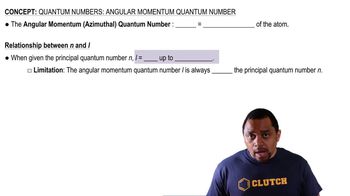
  • What is the relationship between the principal quantum number (n) and the angular momentum quantum number (l)?

    l can have integer values from 0 up to n-1, so l is always less than n.
  • What subshell letter corresponds to l = 0?

    The s subshell corresponds to l = 0.
  • What subshell letter corresponds to l = 1?

    The p subshell corresponds to l = 1.
  • What subshell letter corresponds to l = 2?

    The d subshell corresponds to l = 2.
  • What subshell letter corresponds to l = 3?

    The f subshell corresponds to l = 3.
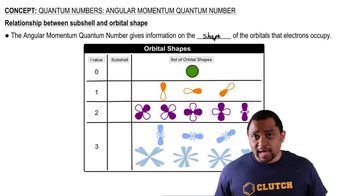
  • What is the shape of an s orbital?

    An s orbital is spherical in shape.
  • How many shapes are associated with the p subshell and what are they called?

    There are 3 shapes, and they are called dumbbells or ellipses.
  • How many shapes are associated with the d subshell and what are their general forms?

    There are 5 shapes: four are clover-shaped and one is a dumbbell with a ring around it.
  • How many shapes are associated with the f subshell and what are their general forms?

    There are 7 shapes: the first three are pacifier-shaped, and the next four are double clover-shaped.
  • What information does the angular momentum quantum number provide about electrons?

    It provides information about the shapes of the orbitals that electrons occupy.
  • If you know the subshell letter, what can you determine about l?

    You can determine the value of l based on the subshell letter (s=0, p=1, d=2, f=3).
  • What is the limitation on the value of l in relation to n?

    l must always be less than n.
  • What is another name for the angular momentum quantum number?

    It is also called the azimuthal quantum number.
  • Why is understanding subshell shapes important in chemistry?

    It is essential for understanding electron configuration and orbital geometry within an atom.