Back

Quantum Numbers: Nodes quiz

Control buttons has been changed to "navigation" mode.
1/15
  • What is a node in quantum mechanics?

    A node is a region within an atom where the probability of finding an electron is zero, meaning there is no electron density.
  • How do you calculate the total number of nodes for an electron in an atom?

    The total number of nodes is equal to the principal quantum number (n) minus 1.
  • What is an electron shell?

    An electron shell is the region where electrons are most likely to be found, representing the highest probability of electron presence.
  • What are the two types of nodes in an atom?

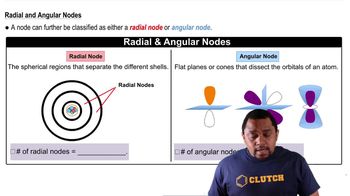
    The two types of nodes are radial nodes and angular nodes.
  • How do you calculate the number of radial nodes?

    The number of radial nodes is calculated as n minus l plus 1, where n is the principal quantum number and l is the angular momentum quantum number.
  • What is a radial node?

    A radial node is a spherical region that separates different electron shells within an atom.
  • How do you calculate the number of angular nodes?

    The number of angular nodes is equal to the angular momentum quantum number (l).
  • What is an angular node?

    An angular node is a flat plane or cone that divides the orbitals of an atom, often in three-dimensional space.
  • If n = 3 and l = 1, how many total nodes are there?

    There are 2 total nodes, since total nodes = n - 1 = 3 - 1 = 2.
  • If n = 3 and l = 1, how many angular nodes are there?

    There is 1 angular node, since angular nodes = l = 1.
  • If n = 3 and l = 1, how many radial nodes are there?

    There are 2 - 1 = 1 radial node, since radial nodes = total nodes - angular nodes = 2 - 1 = 1.
  • Why is most of the atom considered empty space?

    Most of the atom is empty space because electrons are very small and occupy regions far apart from the nucleus.
  • What does a node indicate about electron density?

    A node indicates that the electron density is zero in that region.
  • What quantum number determines the number of angular nodes?

    The angular momentum quantum number (l) determines the number of angular nodes.
  • Why is it important to understand nodes in quantum mechanics?

    Understanding nodes helps explain the structure and behavior of electrons in atoms, which is essential for quantum mechanics.