Back

Radioactive Half-Life quiz

Control buttons has been changed to "navigation" mode.
1/15
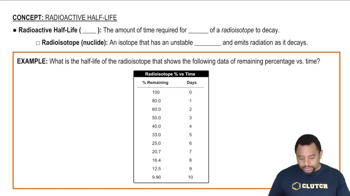
  • What is the definition of radioactive half-life?

    Radioactive half-life is the amount of time required for half of a radioisotope to decay.
  • What is a radioisotope or nuclide?

    A radioisotope or nuclide is an isotope with an unstable nucleus that emits radiation as it decays.
  • Name two types of radioactive decay mentioned in the lesson.

    Two types of radioactive decay mentioned are alpha decay and beta decay.
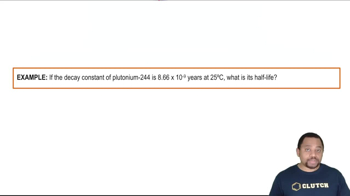
  • What is the formula for calculating radioactive half-life?

    The formula is t₁/₂ = ln(2)/k, where k is the decay constant.
  • What is the approximate value of ln(2) used in the half-life equation?

    The approximate value of ln(2) is 0.693.
  • What does the decay constant (k) represent in the half-life equation?

    The decay constant (k) represents the probability per unit time that a nucleus will decay.
  • Is the half-life of a radioisotope dependent on its initial concentration?

    No, the half-life is not dependent on the initial concentration of the substance.
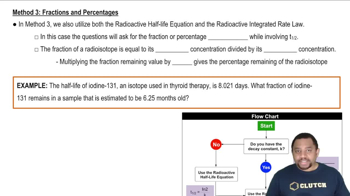
  • If a sample starts with 100% of a radioisotope, what percentage remains after one half-life?

    After one half-life, 50% of the original radioisotope remains.
  • How does the percentage of a radioisotope change after two half-lives?

    After two half-lives, 25% of the original radioisotope remains.
  • What does a plot of half-life versus time look like for a radioisotope?

    The plot is a flat, straight line, indicating that half-life remains constant over time.
  • If a radioisotope has a half-life of 3 days, how much of the original sample remains after 6 days?

    After 6 days (two half-lives), 25% of the original sample remains.
  • What is the relationship between half-life and the decay constant?

    Half-life is inversely proportional to the decay constant.
  • Why is understanding half-life important in nuclear medicine?

    Understanding half-life is important in nuclear medicine for determining how long a radioisotope will remain active in the body.
  • What order of reaction does radioactive decay follow according to the lesson?

    Radioactive decay follows first order rate law rules.
  • What happens to the half-life if the decay constant increases?

    If the decay constant increases, the half-life decreases.