Back

Selective Precipitation quiz

Control buttons has been changed to "navigation" mode.
1/15
  • What is selective precipitation used for in chemistry?

    Selective precipitation is used to separate ions from a solution by forming a precipitate with a reagent that binds to the desired ions.
  • What role does a reagent play in selective precipitation?

    A reagent is an ion that binds to dissolved ions and causes them to precipitate out of the solution.
  • How does the solubility product constant (Ksp) affect selective precipitation?

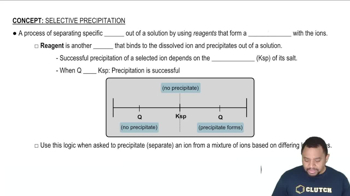
    The success of selective precipitation depends on the Ksp of the salt formed; lower Ksp means the salt is less soluble and more likely to precipitate.
  • What happens when the reaction quotient (Q) is greater than Ksp?

    When Q > Ksp, precipitation occurs as the system shifts to restore equilibrium, forming a solid.
  • What is the result if Q is less than Ksp in a solution?

    If Q < Ksp, the reaction shifts forward, producing more ions and no precipitate forms.
  • What does it mean when Q equals Ksp?

    When Q = Ksp, the system is at equilibrium and no precipitate forms.
  • Why does precipitation occur only when Q exceeds Ksp?

    Precipitation occurs because the system shifts in the reverse direction to restore equilibrium, forming a solid.
  • How can selective precipitation separate specific ions from a mixture?

    By choosing reagents that will precipitate the target ion first, based on differing Ksp values.
  • What is the general process for selective precipitation?

    It involves adding a reagent to a mixture of ions to form a precipitate with the ion that has the lowest Ksp.
  • What happens to the chemical reaction when Q < Ksp?

    The reaction shifts forward, making more ions and moving away from solid, so no precipitate forms.
  • What is the significance of Ksp in selective precipitation?

    Ksp determines the solubility of a salt and which ion will precipitate first when reagents are added.
  • How do you decide which ion will precipitate first in a mixture?

    The ion whose salt has the lowest Ksp will precipitate first when the appropriate reagent is added.
  • What is the effect of adding a reagent to a mixture of ions?

    The reagent binds to certain ions, forming a precipitate and separating those ions from the solution.
  • What direction does the reaction shift when Q > Ksp?

    The reaction shifts in the reverse direction, toward forming a solid (precipitate).
  • Why is understanding Ksp important for selective precipitation?

    Understanding Ksp is crucial for choosing the right reagent and successfully separating ionic compounds by precipitation.