Back

Skeletal Formula quiz

Control buttons has been changed to "navigation" mode.
1/15
  • What is another name for a skeletal formula in organic chemistry?

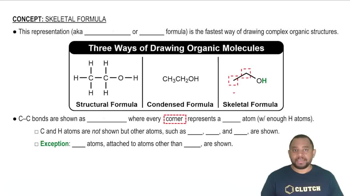
    Skeletal formulas are also known as bond line or line formulas.
  • How are carbon-carbon bonds represented in a skeletal formula?

    Carbon-carbon bonds are shown as lines, with each corner representing a carbon atom.
  • Which atoms are explicitly shown in skeletal formulas besides carbon and hydrogen?

    Heteroatoms such as oxygen, nitrogen, and sulfur are explicitly shown in skeletal formulas.
  • Are hydrogen atoms attached to carbon shown in skeletal formulas?

    No, hydrogen atoms attached to carbon are not shown in skeletal formulas.
  • When are hydrogen atoms shown in skeletal formulas?

    Hydrogen atoms are shown when they are attached to atoms other than carbon, such as oxygen.
  • Why are skeletal formulas used instead of structural or condensed formulas for complex molecules?

    Skeletal formulas are faster and more efficient for drawing complex organic structures.
  • How many bonds must a carbon atom make in a skeletal formula?

    A carbon atom must make four bonds in a skeletal formula.
  • What does each corner or endpoint in a skeletal formula represent?

    Each corner or endpoint represents a carbon atom.
  • How are invisible hydrogens determined in a skeletal formula?

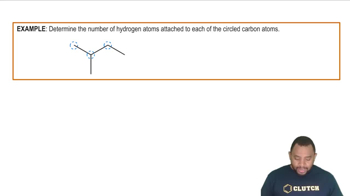
    Invisible hydrogens are implied to satisfy carbon's tetravalency, based on the number of bonds shown.
  • What is the main advantage of using skeletal formulas in organic chemistry?

    They simplify the depiction of molecules, making it easier to visualize and understand larger structures.
  • How does a skeletal formula relate to structural and condensed formulas?

    A skeletal formula represents the same connectivity as structural and condensed formulas but in a simplified way.
  • What is omitted in skeletal formulas to make them more efficient?

    Individual carbon and hydrogen atoms, as well as their bonds, are omitted unless attached to heteroatoms.
  • Why do organic chemists increasingly use skeletal formulas as their proficiency grows?

    Skeletal formulas provide clarity and speed in communication for complex molecules.
  • What is the exception to not showing hydrogen atoms in skeletal formulas?

    Hydrogen atoms attached to heteroatoms like oxygen are shown.
  • How does a skeletal formula help in visualizing organic compounds?

    It streamlines the representation, allowing for quick and clear visualization of molecular connectivity.