Back

Standard Reduction Potentials quiz

Control buttons has been changed to "navigation" mode.
1/15
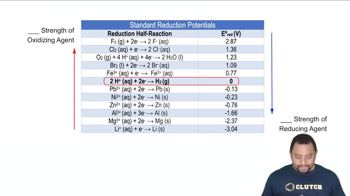
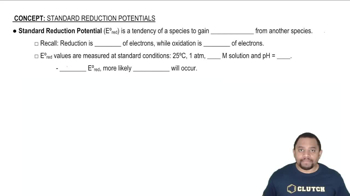
  • What does a higher standard reduction potential (E°) indicate about a species' likelihood to be reduced?

    A higher E° means the species is more likely to gain electrons and undergo reduction.
  • Under what standard conditions are standard reduction potentials measured?

    They are measured at 25°C, 1 atmosphere pressure, 1 M concentration, and pH 7.
  • What is the standard reduction potential (E°) of the standard hydrogen electrode (SHE)?

    The SHE has a standard reduction potential of 0 volts.
  • How can you identify a reduction half-reaction in a standard reduction potential table?

    Reduction half-reactions have electrons as reactants and the oxidation number of the element decreases.
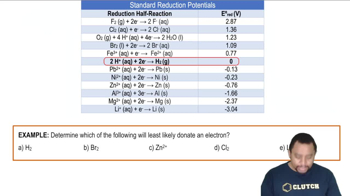
  • What does it mean if a species has an E° value below zero?

    It is more likely to lose electrons (be oxidized) and acts as a strong reducing agent.
  • What is the relationship between being reduced and being an oxidizing agent?

    A species that is reduced acts as the oxidizing agent in a redox reaction.
  • Which element in the standard reduction potential table is the strongest oxidizing agent?

    Fluorine (F₂) is the strongest oxidizing agent because it has the highest E° value.
  • What happens to the likelihood of oxidation as you move down the standard reduction potential table?

    The likelihood of oxidation increases as E° values decrease.
  • If a species is being oxidized, what kind of agent is it?

    It is acting as the reducing agent.
  • How does the strength of being a reducing agent change as E° values decrease?

    The strength of being a reducing agent increases as E° values decrease.
  • What is the significance of the SHE in comparing standard reduction potentials?

    The SHE serves as the reference point (E° = 0) for all other standard reduction potentials.
  • How can you tell if a half-reaction represents a reduction by looking at the electrons?

    If electrons are on the reactant side, the half-reaction represents a reduction.
  • What does a positive E° value suggest about a species' behavior in a redox reaction?

    A positive E° value suggests the species is more likely to be reduced and act as an oxidizing agent.
  • What is the relationship between standard reduction potential and the strength of an oxidizing agent?

    The higher the standard reduction potential, the stronger the oxidizing agent.
  • Why is it important to compare standard reduction potentials of different elements?

    Comparing E° values helps predict the direction of redox reactions and identify oxidizing and reducing agents.