Back

The Electron Configuration: Quantum Numbers quiz

Control buttons has been changed to "navigation" mode.
1/15
  • What does the principal quantum number (n) indicate about an electron in an atom?

    It indicates the size and energy of the electron shell; higher n means electrons are in outer shells.
  • What is the angular momentum quantum number (l) also called?

    It is also called the azimuthal quantum number.
  • Which values of l correspond to the s, p, d, and f subshells?

    s = 0, p = 1, d = 2, f = 3.
  • What does the magnetic quantum number (ml) specify?

    It specifies the orientation of an orbital within a subshell, with values ranging from -l to +l.
  • How many orbitals are in a d subshell and what are their ml values?

    There are 5 orbitals with ml values of -2, -1, 0, +1, and +2.
  • What is the maximum number of electrons that can occupy a single orbital?

    A single orbital can hold a maximum of 2 electrons.
  • What are the possible values for the spin quantum number (ms)?

    The possible values are +1/2 (up-spin) and -1/2 (down-spin).
  • What principle dictates the order in which electrons fill orbitals?

    The Aufbau principle dictates the order of electron filling in orbitals.
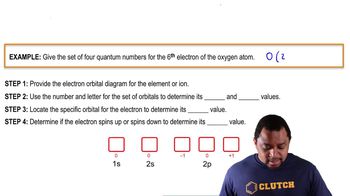
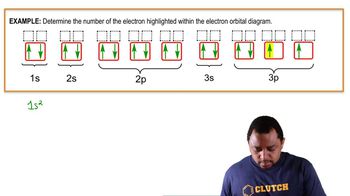
  • How are electrons numbered in an electron configuration diagram?

    Electrons are numbered in the order they are written, following the Aufbau principle.
  • What does the set of quantum numbers collectively describe?

    They collectively describe an electron's unique position and energy in an atom.
  • If an electron is in a 7d orbital, what is its principal quantum number (n)?

    Its principal quantum number is n = 7.
  • What is the l value for an electron in a p orbital?

    The l value for a p orbital is 1.
  • How do you determine the ml values for a given subshell?

    ml values range from -l to +l for the subshell's l value.
  • What is the significance of the ms value for electrons in the same orbital?

    One electron has ms = +1/2 (up-spin) and the other has ms = -1/2 (down-spin), distinguishing their spins.
  • Why is understanding quantum numbers important in chemistry?

    Quantum numbers are essential for determining the location and energy levels of electrons within an atom.