Back

The Electron Configurations: Exceptions quiz

Control buttons has been changed to "navigation" mode.
1/15
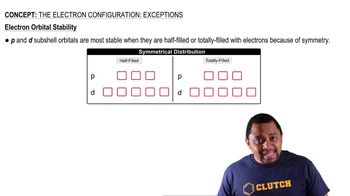
  • Why are p and d subshells most stable when they are half-filled or completely filled?

    Because of symmetry, half-filled or fully-filled p and d subshells provide greater stability to the atom.
  • What rule explains why electrons fill degenerate orbitals singly before pairing up?

    Hund's rule states that electrons fill degenerate orbitals singly to maximize stability before pairing.
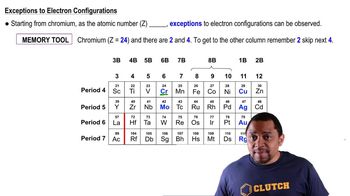
  • Which element marks the start of exceptions to electron configurations in the transition metals?

    Chromium (Cr) marks the start of exceptions to electron configurations among transition metals.
  • How many major elements commonly exhibit exceptions to their electron configurations?

    Six major elements commonly exhibit exceptions to their electron configurations.
  • What is the expected electron configuration for chromium before considering exceptions?

    The expected configuration is [Ar] 4s2 3d4 for chromium.
  • What is the actual electron configuration for chromium due to its exception?

    Chromium's actual configuration is [Ar] 4s1 3d5, achieving a half-filled d subshell.
  • Why does chromium promote an electron from the 4s orbital to the 3d orbital?

    Chromium promotes an electron to achieve a half-filled 3d5 configuration, which is more stable.
  • Which element exhibits an exception by achieving a completely filled d subshell?

    Copper (Cu) exhibits an exception by achieving a completely filled 3d10 subshell.
  • What is the expected electron configuration for copper before considering exceptions?

    The expected configuration is [Ar] 4s2 3d9 for copper.
  • What is the actual electron configuration for copper due to its exception?

    Copper's actual configuration is [Ar] 4s1 3d10, with a fully-filled d subshell.
  • What is the driving force behind the exceptions in electron configurations for certain elements?

    The drive to achieve half-filled or fully-filled d orbitals causes these exceptions.
  • Which four elements are skipped between chromium and copper when identifying exceptions?

    Manganese, iron, cobalt, and nickel are skipped between chromium and copper.
  • What happens to the s orbital electron in elements showing electron configuration exceptions?

    An s orbital electron is promoted to the d orbital to achieve greater stability.
  • How does the electron configuration change for a d4 element to become more stable?

    A d4 element promotes an s electron to become d5, resulting in a half-filled d subshell.
  • What is the key indicator in electron configurations that suggests an exception may occur?

    Ending with d4 or d9 in the configuration signals a possible exception due to the drive for half-filled or fully-filled d orbitals.