Which choice is an accurate definition of a hypothesis?
A hypothesis is a proposed, testable explanation for an observation, predicting what and why something will happen.
Which statement best describes the scientific method?
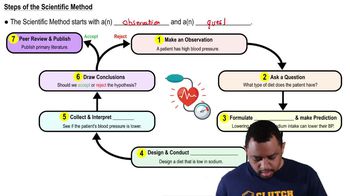
The scientific method is a procedure used to answer questions, test ideas, and gain scientific knowledge through a series of steps including observation, hypothesis formulation, experimentation, and conclusion.
What is a controlled experiment?
A controlled experiment is one in which only one variable is changed at a time while all other variables are kept constant to test the effect of the independent variable.
What is the purpose of controlling the environment when testing a hypothesis?
Controlling the environment ensures that the results of an experiment are due to the variable being tested and not other factors.
Which is one way that scientists communicate the results of an experiment?
Scientists communicate the results of an experiment by publishing their findings in peer-reviewed journals.
What is an example of deductive reasoning?
A) All men are mortal. Socrates is a man. Therefore, Socrates is mortal.
How do hypotheses differ from theories in science?
Hypotheses are testable predictions, while theories are well-supported explanations.
Which statement best describes a scientific question?
A scientific question is one that can be answered through empirical observation and experimentation.
How is a control group treated in a scientific experiment?
A control group is treated exactly the same as the experimental group except that it does not receive the experimental treatment or variable.
Which is the correct order in the scientific process?
The correct order is: observation, question, hypothesis, prediction, experiment, data collection, conclusion.
What is a false statement about scientific experiments?
They can prove a hypothesis true.
What is the purpose of a control group in scientific experiments?
The purpose of a control group is to provide a baseline that allows researchers to compare the effects of the experimental variable.
Which best describes the purpose of a controlled experiment?
The purpose of a controlled experiment is to isolate the effect of the independent variable on the dependent variable.
Why is it important to have a control group in an experiment?
A control group is important because it allows for comparison and helps to ensure that the results are due to the variable being tested.
What is a false statement about scientific theories?
They can be proven true.
Creating a testable hypothesis falls between which two steps of the scientific method?
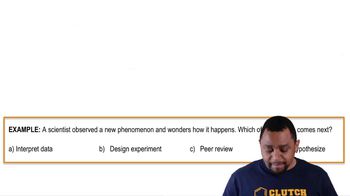
Creating a testable hypothesis falls between asking a question and making a prediction.
When are hypotheses supported in science?
Hypotheses are supported when experimental data consistently align with the predictions made by the hypothesis.
Which best describes the role of communication in scientific investigations?
Communication in scientific investigations involves sharing results through peer-reviewed publications to validate findings and advance knowledge.
Creating a testable hypothesis comes after which step in the scientific method?
Creating a testable hypothesis comes after making an observation and asking a question.
How is discovery-based science conducted?
Discovery-based science is conducted through observation and data collection without a preconceived hypothesis.
What is an example of a good scientific question?
How does temperature affect the rate of enzyme activity?
Which statement could not be supported or rejected by a scientific experiment?
C) The universe is infinite.
Which sentence best describes the logic of scientific inquiry?
Scientific inquiry involves forming hypotheses, conducting experiments, and drawing conclusions based on empirical evidence.
Which statement is not a hypothesis?
C) The sky is blue because of the ocean.
Which of these statements are true about scientific theories and hypotheses? A) Theories are guesses, while hypotheses are proven facts. B) Theories are broader than hypotheses and are supported by a large body of evidence. C) Hypotheses can be proven true.
B) Theories are broader than hypotheses and are supported by a large body of evidence.
What best describes the logic of scientific inquiry?
It involves making observations and forming hypotheses.
What is the fourth step of the scientific method?
The fourth step of the scientific method is making a prediction based on the hypothesis.
In order for a hypothesis to be able to be used in science, it must be...
In order for a hypothesis to be used in science, it must be testable and falsifiable.
What is an example of a testable hypothesis?
Increasing the amount of sunlight will increase plant growth.
Why are hypotheses so important to controlled experiments?
Hypotheses are important because they provide a focused question that the experiment is designed to test.
Following a scientific method, what is the first step?
The first step in the scientific method is making an observation.
Which refers to information gathered by the systematic study of nature?
Information gathered by the systematic study of nature is referred to as data.
What is not a key element of the scientific method?
Opinion
What is not part of the scientific method?
Making assumptions
What process is a foundation of scientific inquiries?
Experimentation
What best describes scientific research?
Scientific research involves systematic investigation to establish facts and reach new conclusions.
What is the second step of the scientific method?
The second step of the scientific method is asking a question based on the observation.
Which statement best describes a scientific theory?
A scientific theory is a well-supported explanation of a natural phenomenon based on a large body of evidence.
How many variables are tested in any controlled experiment?
In a controlled experiment, only one variable is tested at a time.
What is the second step in the scientific method?
The second step in the scientific method is asking a question.
 Back
Back
 00:46
00:46