What is an example of a question that science cannot answer?
What is the purpose of life?
Which statement about the universe cannot be tested by science?
The universe is infinite.
What is the best description of science?
Science is a systematic enterprise that builds and organizes knowledge in the form of testable explanations and predictions about the universe.
How should scientists set up the control group in this experiment?
Scientists should set up the control group by ensuring it does not receive the experimental treatment and is kept under the same conditions as the experimental group.
How many variables can be tested in a controlled experiment?
In a controlled experiment, only one variable can be tested at a time.
What is the fourth step in the scientific method?
The fourth step in the scientific method is making a prediction based on the hypothesis.
Which step of the scientific method is a proposed explanation for an observation?
Formulating a hypothesis is the step of the scientific method that involves proposing an explanation for an observation.
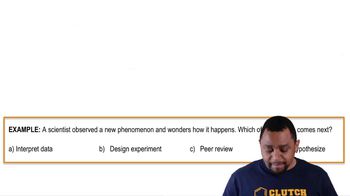
What is the term for the second step in the scientific process?
The term for the second step in the scientific process is 'asking a question.'
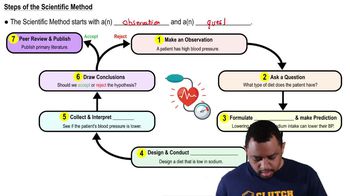
What is the correct sequence of steps in the scientific method?
The correct sequence is: observation, question, hypothesis, prediction, experiment, data collection, conclusion.
What is true of scientific literature?
Scientific literature is peer-reviewed and published to communicate research findings to the scientific community.
What is a testable explanation used to examine or test the phenomena?
A testable explanation used to examine or test phenomena is called a hypothesis.
Which is a testable explanation?
A hypothesis is a testable explanation.
What is an example of a hypothesis related to temperature and solubility?
If I increase the temperature, the solubility of sugar in water will increase.
What type of inquiry is outside the realm of science?
Debating the existence of ghosts
Which characteristic is not part of science: testability, falsifiability, or certainty?
Certainty
What describes a hypothesis?
A hypothesis is a proposed, testable explanation for an observation, predicting what and why something will happen.
Which of the statements below is not part of the scientific method? A) Observation B) Hypothesis C) Assumption
C) Assumption
Which question can be answered using the scientific process? A) What is the meaning of life? B) How does temperature affect the rate of enzyme activity? C) Why is the sky blue?
B) How does temperature affect the rate of enzyme activity?
Which example best describes using technology in science?
Using technology in science involves employing instruments and tools to gather data and conduct experiments.
What is a controlled experiment?
A controlled experiment is one in which only one variable is changed at a time while all other variables are kept constant.
Which describes the best approach when conducting a scientific experiment?
The best approach is to control variables, use a control group, and ensure the experiment is repeatable and unbiased.
Which step of scientific inquiry involves testing the hypothesis and collecting data?
The experimentation step involves testing the hypothesis and collecting data.
What is the difference between a hypothesis and a scientific theory?
A hypothesis is a testable prediction, while a scientific theory is a well-supported explanation based on a large body of evidence.
What is the control or control group in an experiment?
The control group in an experiment is the group that does not receive the experimental treatment and is used as a baseline for comparison.
Which statement describes a controlled experiment?
A controlled experiment is one in which only one variable is changed at a time while all other variables are kept constant.
What is the correct order for the scientific method?
The correct order is: observation, question, hypothesis, prediction, experiment, data collection, conclusion.
What is the difference between technology and science?
Science is the systematic study of the natural world, while technology is the application of scientific knowledge for practical purposes.
Which most accurately describes the basis of the scientific method?
The basis of the scientific method is systematic observation, measurement, and experimentation, and the formulation, testing, and modification of hypotheses.
Why might a scientist use a model to answer the question you selected?
A scientist might use a model to simplify complex systems, make predictions, and test hypotheses in a controlled environment.
Why can a hypothesis never be proven to be true?
A hypothesis can never be proven true because future evidence may contradict it; it can only be supported or falsified.
Why is it important that the scientific method is a structured step-by-step process?
A structured step-by-step process ensures consistency, reliability, and reproducibility in scientific investigations, allowing results to be verified and built upon by others.
How do scientific laws differ from scientific theories?
Scientific laws describe consistent, universal observations, while theories explain the underlying reasons for those observations and are supported by a large body of evidence.
What step of the scientific method reviews your original question and your hypothesis?
The conclusion step reviews the original question and hypothesis to determine if the results support or refute the hypothesis.
What defines a scientific law?
A scientific law is a statement that describes a consistent, universally observed phenomenon, such as 'energy cannot be created or destroyed.'
What is a control in a scientific experiment?
A control is a standard for comparison in an experiment, ensuring that the results are due to the variable being tested.
Which of these are basic elements of the scientific method?
Basic elements include observation, hypothesis, prediction, experiment, data collection, interpretation, and conclusion.
What are the steps of the scientific method in order?
The steps are: observation, question, hypothesis, prediction, experiment, data collection and interpretation, and conclusion.
A good scientific experiment is reproducible. What does this mean?
It means that other scientists can repeat the experiment and obtain similar results.
What are the steps of the scientific method?
The steps are: observation, question, hypothesis, prediction, experiment, data collection and interpretation, and conclusion.
 Back
Back
 00:46
00:46