Back

Titrations: Diprotic & Polyprotic Buffers quiz

Control buttons has been changed to "navigation" mode.
1/15
  • What is a diprotic acid and how many dissociation steps does it have?

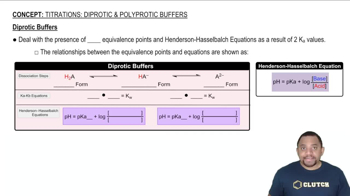
    A diprotic acid has two acidic hydrogens and can dissociate twice, each step with its own unique Ka value.
  • What are the forms of a diprotic acid during its dissociation?

    The forms are H2A (acidic), HA− (intermediate), and A2− (basic).
  • Which Ka value corresponds to the loss of the first acidic hydrogen in a diprotic acid?

    Ka1 corresponds to the loss of the first acidic hydrogen, converting H2A to HA−.
  • What is the intermediate form in a diprotic acid dissociation?

    The intermediate form is HA−, which has lost one H+ but can lose another.
  • How are Ka and Kb values paired in diprotic acids?

    Ka1 pairs with Kb2, and Ka2 pairs with Kb1, each product equaling Kw.
  • What is the general form of the Henderson-Hasselbalch equation?

    The equation is pH = pKa + log(base/acid).
  • How many Henderson-Hasselbalch equations are used for diprotic buffers?

    Two equations are used, one for each dissociation step.
  • What forms are used in the first Henderson-Hasselbalch equation for diprotic buffers?

    The acidic form (H2A) and the intermediate form (HA−) are used.
  • What forms are used in the second Henderson-Hasselbalch equation for diprotic buffers?

    The intermediate form (HA−) and the basic form (A2−) are used.
  • What is a triprotic acid and how many dissociation steps does it have?

    A triprotic acid has three acidic hydrogens and dissociates in three steps, each with its own Ka value.
  • What are the forms of a triprotic acid during its dissociation?

    The forms are H3A (acidic), H2A− (intermediate 1), HA2− (intermediate 2), and A3− (basic).
  • How are Ka and Kb values paired in triprotic acids?

    Ka1 pairs with Kb3, Ka2 with Kb2, and Ka3 with Kb1, each product equaling Kw.
  • How many Henderson-Hasselbalch equations are used for triprotic buffers?

    Three equations are used, one for each dissociation step.
  • Which forms are used in the first Henderson-Hasselbalch equation for triprotic buffers?

    The acidic form (H3A) and intermediate form 1 (H2A−) are used.
  • Why is understanding Ka, Kb, and Henderson-Hasselbalch equations important in polyprotic buffer systems?

    It is essential for calculating pH changes and understanding the relationships between different forms in polyprotic buffers.