Back

Using Hess's Law To Determine K quiz

Control buttons has been changed to "navigation" mode.
1/15
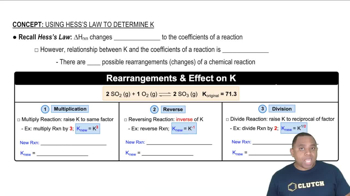
  • What happens to the equilibrium constant K if you multiply all the coefficients in a chemical reaction by 3?

    K is raised to the third power (K^3), so the new K becomes the original K cubed.
  • How does reversing a chemical reaction affect the equilibrium constant K?

    Reversing the reaction takes the inverse of K, so the new K is 1 divided by the original K.
  • If you divide all the coefficients in a reaction by 2, what happens to K?

    K is raised to the one-half power (K^0.5), which is the square root of the original K.
  • Is the relationship between K and the coefficients of a reaction linear or exponential?

    The relationship is exponential, not linear.
  • What is the new K value if the original K is 71.3 and the reaction is multiplied by 3?

    The new K is 71.3 cubed, which equals 362,467.097.
  • What is the new K value if the original K is 71.3 and the reaction is reversed?

    The new K is 1/71.3, which equals 0.0140.
  • What is the new K value if the original K is 71.3 and the reaction is divided by 2?

    The new K is the square root of 71.3, which is 8.44.
  • What does multiplying a reaction by a factor n do to the equilibrium constant K?

    It raises K to the nth power (K^n).
  • What does dividing a reaction by a factor n do to the equilibrium constant K?

    It raises K to the 1/n power (K^(1/n)).
  • What does it mean to reverse a chemical reaction in terms of reactants and products?

    Reversing a reaction swaps the reactants and products.
  • If a reaction is divided by 3, how is K affected?

    K is raised to the one-third power (K^(1/3)).
  • If a reaction is multiplied by 4, what happens to K?

    K is raised to the fourth power (K^4).
  • Why is it important to understand how changes to a reaction affect K?

    Because these changes can significantly impact the equilibrium constant and the system's behavior.
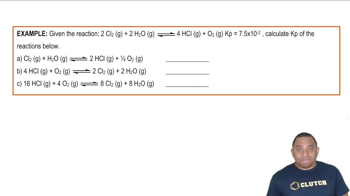
  • What is the effect on K if you reverse and then multiply a reaction by 2?

    K becomes the inverse raised to the second power, or (1/K)^2.
  • How does the effect of changing coefficients on K differ from its effect on ΔH (enthalpy)?

    ΔH changes proportionally with coefficients, while K changes exponentially.