Back

Velocity Distributions quiz

Control buttons has been changed to "navigation" mode.
1/15
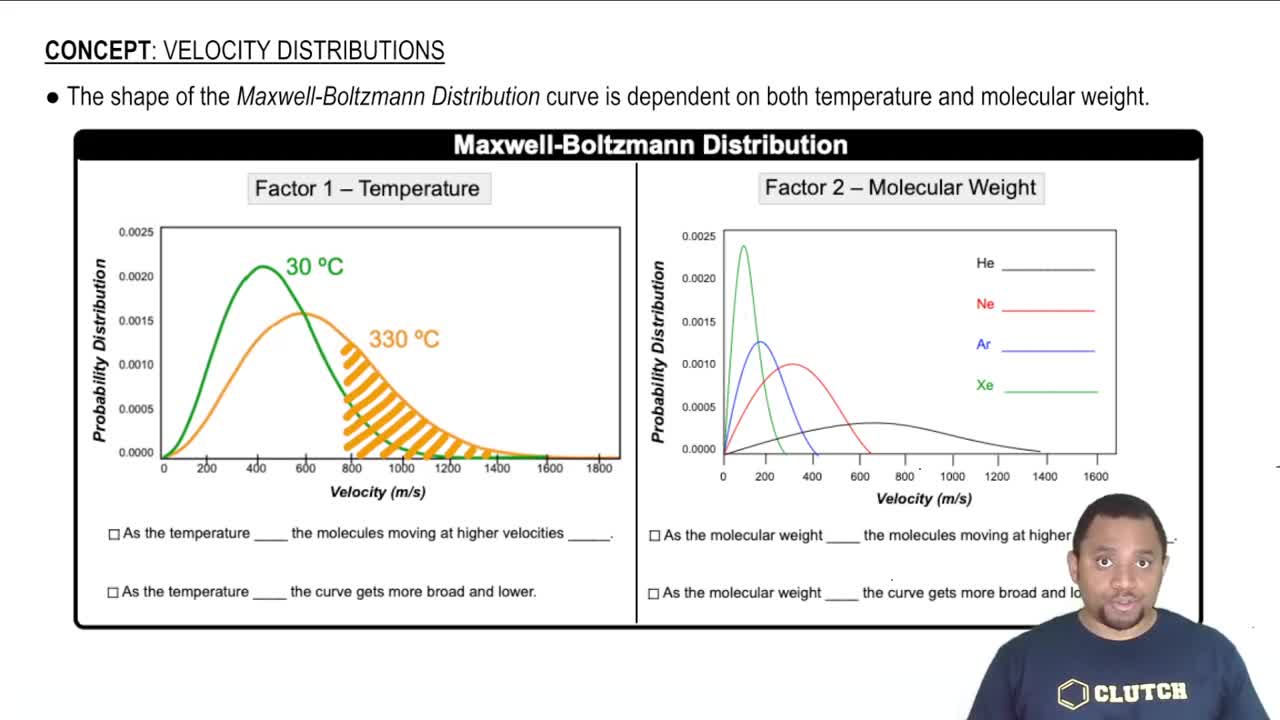
  • What are the two main factors that affect the shape of the Maxwell-Boltzmann distribution curve?

    Temperature and molecular weight are the two main factors.
  • How does increasing temperature affect the probable speed of gas molecules?

    Increasing temperature raises the probable speed, so more molecules move at higher velocities.
  • At higher temperatures, how does the Maxwell-Boltzmann curve change in shape?

    The curve becomes broader and lower, indicating a wider range of velocities.
  • What happens to the number of gas molecules moving at 800 m/s or more when temperature increases?

    The number of molecules moving at 800 m/s or more increases with higher temperature.
  • How does increasing molecular weight affect the probable speed of a gas?

    Increasing molecular weight decreases the probable speed, so heavier gases move slower.
  • Which gas, helium or xenon, has a higher probable speed and why?

    Helium has a higher probable speed because it has a lower molecular weight.
  • How does the Maxwell-Boltzmann curve for helium compare to that for xenon?

    Helium's curve is broader and lower, while xenon's is narrower and higher.
  • What does a broader Maxwell-Boltzmann curve indicate about the velocities of gas molecules?

    A broader curve means there is a wider range of velocities among the molecules.
  • What trend is observed in the Maxwell-Boltzmann curve as molecular weight decreases?

    As molecular weight decreases, the curve becomes broader and lower.
  • Why do heavier gases like xenon move slower than lighter gases like helium?

    Heavier gases move slower because it is harder for them to achieve high velocities due to their greater mass.
  • What is the probable speed for helium compared to xenon, based on the transcript?

    Helium's probable speed is around 700 m/s, while xenon's is about 100 m/s.
  • How does the Maxwell-Boltzmann curve change for gases with higher molecular weights?

    The curve becomes narrower and peaks higher, indicating a more limited range of velocities.
  • What does the apex of the Maxwell-Boltzmann curve represent?

    The apex represents the probable speed, where the majority of gas molecules move.
  • How does the number of molecules at high velocities change with increasing temperature?

    With increasing temperature, more molecules achieve higher velocities.
  • Why is understanding the trends in velocity distributions important for studying gases?

    It helps explain the behavior of gaseous molecules under different conditions, such as changes in temperature and molecular weight.