Back
BackAtoms, Molecules, and Ions: Foundations of Chemical Structure and Nomenclature
Study Guide - Smart Notes
 Tailored notes based on your materials, expanded with key definitions, examples, and context.
Atoms, Molecules, and Ions
Atomic Theory of Matter
The atomic theory of matter, first systematically formulated by John Dalton in the early nineteenth century, posits that atoms are the fundamental building blocks of all matter. Dalton's theory provided a scientific explanation for the composition and transformation of substances.
Atoms are indivisible particles that make up elements.
Each element consists of identical atoms, distinct from those of other elements.
Atoms are neither created nor destroyed in chemical reactions; they are simply rearranged.
Compounds are formed when atoms of different elements combine in fixed ratios.
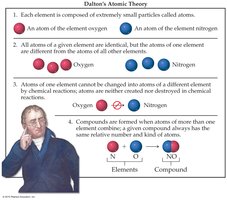
Dalton’s Postulates
Dalton's postulates summarize the foundational ideas of atomic theory:
Postulate 1: Each element is composed of extremely small particles called atoms.
Postulate 2: All atoms of a given element are identical in mass and properties, but differ from atoms of other elements.
Postulate 3: Atoms are not changed into different elements by chemical reactions; they are neither created nor destroyed.
Postulate 4: Compounds are formed when atoms of more than one element combine; a given compound always has the same relative number and kind of atoms.
Fundamental Laws of Chemistry
Law of Conservation of Mass: The total mass of substances remains constant during a chemical reaction.
Law of Multiple Proportions: When two elements form more than one compound, the masses of one element that combine with a fixed mass of the other are in ratios of small whole numbers.
Discovery of Subatomic Particles
Although Dalton considered atoms indivisible, later experiments revealed that atoms are composed of smaller subatomic particles: electrons, protons, and neutrons.
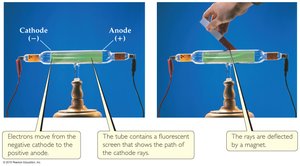
Electrons: Discovered by J.J. Thomson through cathode ray experiments as negatively charged particles.
Protons: Positively charged particles found in the nucleus.
Neutrons: Neutral particles also located in the nucleus.
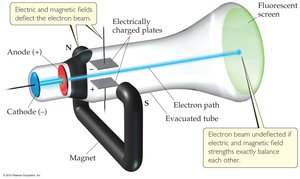
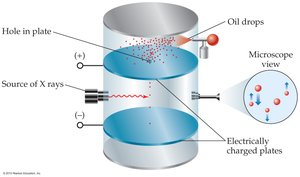
Radioactivity
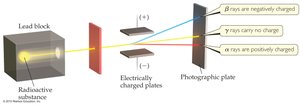
Radioactivity is the spontaneous emission of radiation by certain elements, first observed by Henri Becquerel and further studied by Marie and Pierre Curie. Ernest Rutherford identified three types of radiation:
Alpha (α) particles: Positively charged
Beta (β) particles: Negatively charged (like electrons)
Gamma (γ) rays: Uncharged
Models of the Atom
Early atomic models evolved as new discoveries were made:
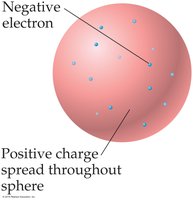
Plum Pudding Model (Thomson): Atoms are spheres of positive charge with embedded electrons.
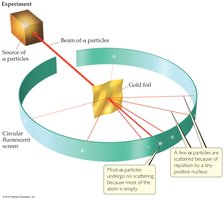
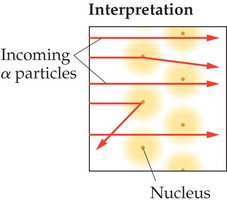
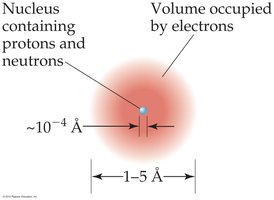
Rutherford Model: Gold foil experiment showed that atoms have a small, dense, positively charged nucleus with electrons around it. Most of the atom is empty space.
Subatomic Particles: Properties and Comparison
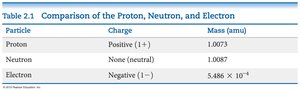
Atoms are composed of protons, neutrons, and electrons, each with distinct properties:
Particle | Charge | Mass (amu) |
|---|---|---|
Proton | +1 | 1.0073 |
Neutron | 0 (neutral) | 1.0087 |
Electron | -1 | 5.486 × 10⁻⁴ |
Atomic Mass and Isotopes
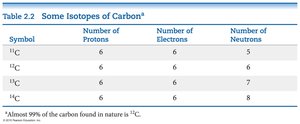
Atomic mass is measured in atomic mass units (amu), where 1 amu = 1.66054 × 10⁻²⁴ g. Isotopes are atoms of the same element with different numbers of neutrons, resulting in different masses.
Atomic Weight: The weighted average of all naturally occurring isotopes of an element.
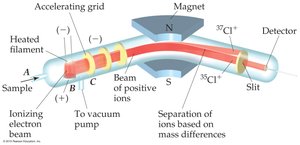
Mass Spectrometry: Used to measure atomic and molecular weights with high accuracy.
Symbol | Number of Protons | Number of Electrons | Number of Neutrons |
|---|---|---|---|
11C | 6 | 6 | 5 |
12C | 6 | 6 | 6 |
13C | 6 | 6 | 7 |
14C | 6 | 6 | 8 |
The Periodic Table
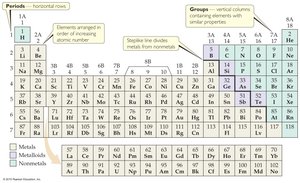
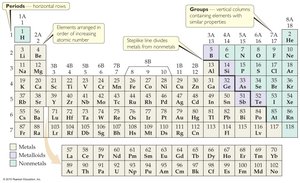
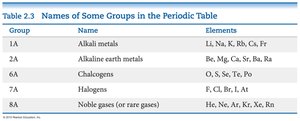
The periodic table organizes elements by increasing atomic number and recurring chemical properties. Elements are arranged in rows (periods) and columns (groups or families).
Groups: Vertical columns; elements in the same group have similar properties.
Periods: Horizontal rows.
Metals: Left side; shiny, conductive, solid (except mercury).
Nonmetals: Right side; can be solid, liquid, or gas.
Metalloids: Along the staircase line; properties intermediate between metals and nonmetals.
Chemical Formulas and Molecular Structure
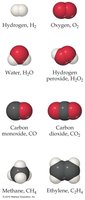
Chemical formulas represent the composition of compounds:
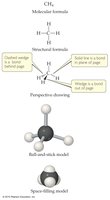
Empirical Formula: Lowest whole-number ratio of atoms.
Molecular Formula: Actual number of atoms of each element.
Structural Formula: Shows the order of atom attachment.
Perspective Drawings/Models: Show three-dimensional arrangement.
Ions and Ionic Compounds
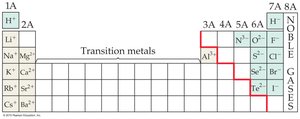
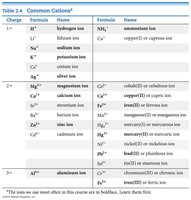
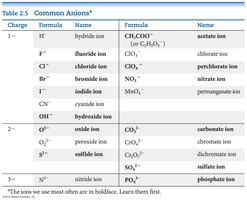
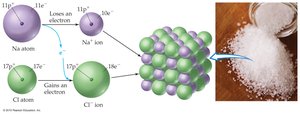
Ions are charged particles formed when atoms gain or lose electrons:
Cations: Positively charged, formed by loss of electrons (usually metals).
Anions: Negatively charged, formed by gain of electrons (usually nonmetals).
Ionic Compounds: Formed from the electrostatic attraction between cations and anions; empirical formulas are used.
Writing Formulas for Ionic Compounds
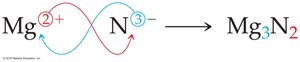
To write the formula for an ionic compound:
The total positive charge must balance the total negative charge.
Subscripts indicate the number of each ion needed for neutrality.
Reduce subscripts to the lowest whole-number ratio.
Nomenclature of Inorganic Compounds
Naming conventions for inorganic compounds:
Cations: Name the element; if variable charge, indicate with Roman numerals.
Anions: For elements, change ending to -ide; for polyatomic ions, use the ion name.
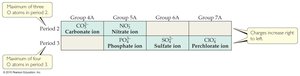
Oxyanions: Fewer oxygens: -ite; more oxygens: -ate. Prefixes hypo- (fewest) and per- (most) are used for series with more than two oxyanions.
Acid Nomenclature
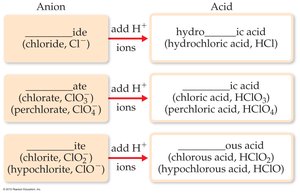
Acids are named based on their anions:
Anion ends in -ide: hydro- prefix and -ic acid suffix (e.g., HCl: hydrochloric acid).
Anion ends in -ite: -ous acid suffix (e.g., HClO: hypochlorous acid).
Anion ends in -ate: -ic acid suffix (e.g., HClO3: chloric acid).
Nomenclature of Binary Molecular Compounds
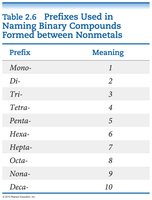
Binary molecular compounds (two nonmetals) are named using prefixes to indicate the number of atoms:
Prefix | Meaning |
|---|---|
Mono- | 1 |
Di- | 2 |
Tri- | 3 |
Tetra- | 4 |
Penta- | 5 |
Hexa- | 6 |
Hepta- | 7 |
Octa- | 8 |
Nona- | 9 |
Deca- | 10 |
The first element is named first; the second element's ending is changed to -ide.
Prefixes are used for both elements except mono- is omitted for the first element.
Nomenclature of Organic Compounds
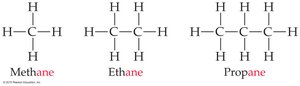
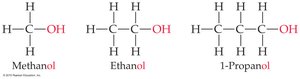
Organic compounds are primarily composed of carbon and hydrogen. The simplest are alkanes, named based on the number of carbon atoms (meth-, eth-, prop-, etc.). When a hydrogen is replaced by a functional group (e.g., -OH), the compound is named accordingly (e.g., alcohols end in -ol).