 Back
BackBasic Principles of Heredity: Mendelian Genetics and Probability
Study Guide - Smart Notes
 Tailored notes based on your materials, expanded with key definitions, examples, and context.
Basic Principles of Heredity
Introduction to Mendelian Genetics
Mendelian genetics forms the foundation of classical genetics, describing how traits are inherited from one generation to the next. Gregor Mendel's experiments with garden peas led to the discovery of key principles that explain the transmission of hereditary information.
Gregor Mendel and His Experiments
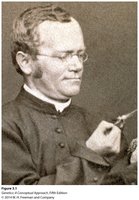
Gregor Mendel (1822–1884) was a monk and teacher who used quantitative experiments to study heredity in garden peas.
He was unaware of chromosomes, genes, or Darwin's theory of natural selection.
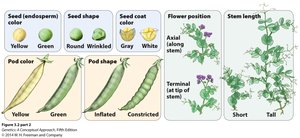
Mendel chose peas for their short generation time, ease of controlled breeding, and availability of purebred varieties with easily distinguishable traits.
Key Genetic Terms
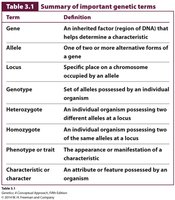
Understanding genetics requires familiarity with several foundational terms:
Term | Definition |
|---|---|
Gene | An inherited factor (region of DNA) that helps determine a characteristic |
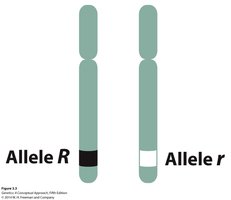
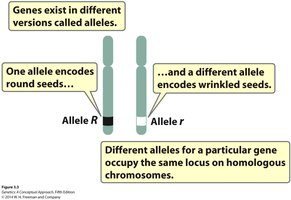
Allele | One of two or more alternative forms of a gene |
Locus | Specific place on a chromosome occupied by an allele |
Genotype | Set of alleles possessed by an individual organism |
Heterozygote | An individual organism possessing two different alleles at a locus |
Homozygote | An individual organism possessing two of the same alleles at a locus |
Phenotype or trait | The appearance or manifestation of a characteristic |
Characteristic or character | An attribute or feature possessed by an organism |
Mendel’s Principles
Genotype vs. Phenotype
Genotype: The genetic makeup (alleles) of an organism at a particular locus.
Phenotype: The observable expression of the genotype, influenced by environmental factors and interactions with other genes.
Monohybrid Crosses
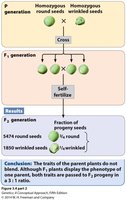
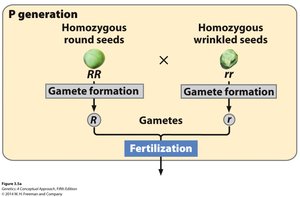
A monohybrid cross examines the inheritance of a single character with two contrasting traits. Mendel's experiments with true-breeding parents (homozygous for each trait) revealed consistent patterns in the F1 and F2 generations.
F1 offspring express only one parental phenotype (dominant trait).
F2 generation shows both parental phenotypes in a 3:1 ratio (dominant:recessive).
Mendel’s Four Major Conclusions
Alleles account for variations in inherited characters. Each organism possesses two alleles for each character.
Law of Segregation: The two alleles for a character separate during gamete formation, so each gamete receives only one allele.
Dominance: If two alleles at a locus differ, the dominant allele determines the phenotype, while the recessive allele is masked.
Equal Probability: When alleles segregate, they are distributed to gametes with equal probability.
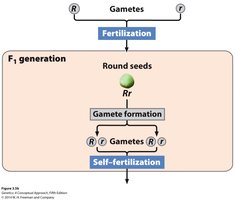
Punnett Squares and Test Crosses
Punnett squares are used to predict the genotypic and phenotypic ratios of offspring from genetic crosses. A test cross can determine the genotype of an individual with a dominant phenotype by crossing it with a homozygous recessive individual.
Punnett Square: Visual tool for predicting offspring ratios.
Test Cross: Cross between an individual with an unknown dominant genotype and a homozygous recessive individual.







Probability in Genetics
Rules of Probability
Rule of Multiplication: The probability that two or more independent events will occur together is the product of their individual probabilities.
Rule of Addition: The probability that either of two or more mutually exclusive events will occur is the sum of their individual probabilities.


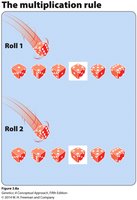
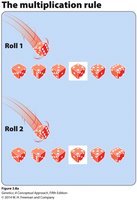
Applying Probability to Genetic Crosses
Probability rules can be used as an alternative to Punnett squares for predicting offspring ratios, especially in complex crosses.
For a cross Aa x Aa: Probability of AA = , Aa = , aa = .
For a cross aa x aa: Probability of Aa offspring = 0% (since only a alleles are present).

Dihybrid Crosses and the Law of Independent Assortment
Dihybrid Crosses
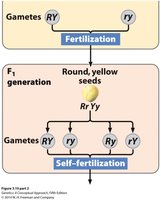
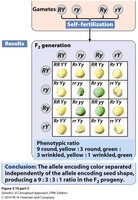
Dihybrid crosses examine the inheritance of two different characters simultaneously. Mendel's experiments showed that alleles for different traits assort independently during gamete formation, leading to the Law of Independent Assortment.
F2 generation from a dihybrid cross shows a 9:3:3:1 phenotypic ratio.
Each gene pair segregates independently during meiosis.
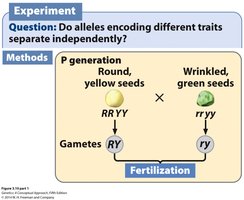
Probability in Dihybrid and Multihybrid Crosses
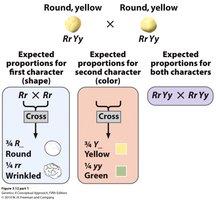
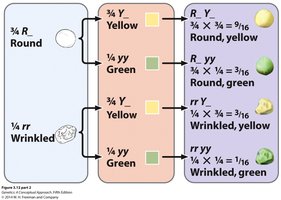
Probability rules can be extended to crosses involving multiple genes. Each gene pair is considered independently, and the overall probability is the product of individual probabilities.
For a cross AaBb x AaBb, probability of AABB offspring = .
For more genes, multiply the probabilities for each gene pair.
Relating Mendel’s Principles to Chromosome Behavior
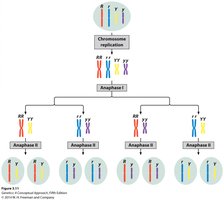
Mendel’s principles are explained by the behavior of chromosomes during meiosis. The segregation of alleles corresponds to the separation of homologous chromosomes, and independent assortment reflects the random orientation of chromosome pairs during metaphase I.
Summary Table: Mendelian Ratios
Cross Type | Genotypic Ratio | Phenotypic Ratio |
|---|---|---|
Monohybrid (Aa x Aa) | 1 AA : 2 Aa : 1 aa | 3 dominant : 1 recessive |
Dihybrid (AaBb x AaBb) | 1 AABB : 2 AABb : 2 AaBB : 4 AaBb : 1 AAbb : 2 Aabb : 1 aaBB : 2 aaBb : 1 aabb | 9 dominant/dominant : 3 dominant/recessive : 3 recessive/dominant : 1 recessive/recessive |
Key Equations
Probability of independent events:
Probability of mutually exclusive events:
Recommended Practice Problems
End-of-chapter problems: 2, 3, 5, 6, 9, 10, 14, 15, 17 (omit c), 18, 19, 20, 22, 25, 28, 30(a), 33, and 34.
