 Back
BackChapter 4: The Major Classes of Chemical Reactions
Study Guide - Smart Notes
 Tailored notes based on your materials, expanded with key definitions, examples, and context.
The Major Classes of Chemical Reactions
Introduction
Chemical reactions in aqueous solutions are central to general chemistry. This chapter explores the major classes of reactions, including precipitation, acid-base, and oxidation-reduction (redox) reactions, with a focus on the role of water as a solvent, writing ionic equations, and understanding chemical equilibrium.
The Role of Water as a Solvent
Polarity of Water Molecules
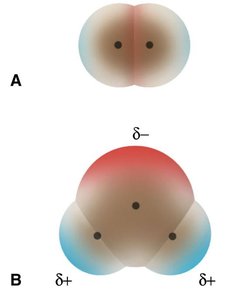
Water is a polar molecule, meaning it has a partial positive charge on the hydrogen atoms and a partial negative charge on the oxygen atom. This polarity allows water to interact with and dissolve many ionic and polar substances.
Electron Distribution: In H2 (hydrogen gas), electrons are evenly distributed. In H2O (water), electrons are drawn toward the oxygen, creating a dipole.
Partial Charges: The oxygen atom in water carries a partial negative charge (δ−), while the hydrogen atoms carry partial positive charges (δ+).
Solvation of Ions
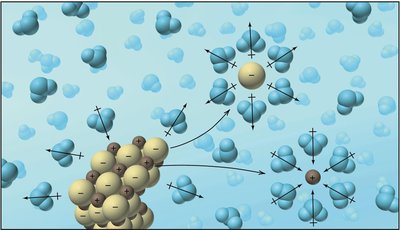
When ionic compounds dissolve in water, the ions are surrounded by water molecules, a process called solvation or hydration. The polar water molecules stabilize the ions in solution.
Writing Equations for Aqueous Ionic Reactions
Types of Equations
Molecular Equation: Shows all reactants and products as intact compounds.
Total Ionic Equation: Shows all soluble ionic substances dissociated into ions.
Net Ionic Equation: Shows only the species that actually change during the reaction, omitting spectator ions.
Precipitation Reactions
Formation of a Precipitate
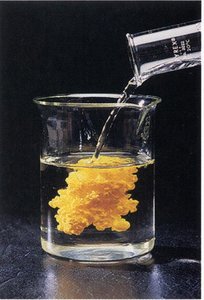
Precipitation reactions occur when two aqueous solutions combine to form an insoluble solid, called a precipitate. The formation of a precipitate can be predicted using solubility rules.
Steps to Predict Precipitation:
Identify the ions present in the reactants.
Consider all possible cation-anion combinations.
Determine if any combination is insoluble using solubility rules.
Example: Silver Chromate Precipitation
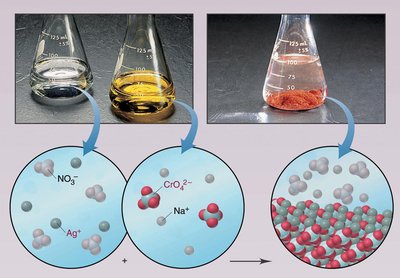
When solutions of silver nitrate and sodium chromate are mixed, a red precipitate of silver chromate forms.



Acid-Base Reactions
Definitions and Properties
Acid: A substance that produces H+ ions in water.
Base: A substance that produces OH− ions in water.
Electrolytes: Acids and bases are electrolytes; their strength depends on the degree of ionization.
Acid-Base Titrations
Titration is a technique to determine the concentration of an unknown acid or base using a solution of known concentration. An indicator is used to detect the endpoint, which is close to the equivalence point where stoichiometric amounts of acid and base have reacted.
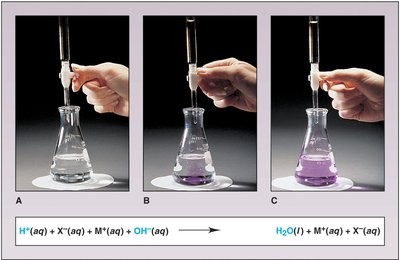


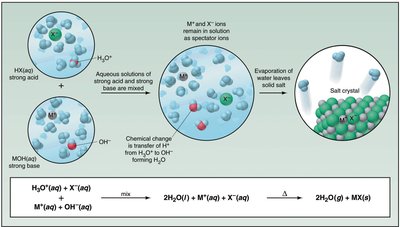
Neutralization Reaction
When a strong acid reacts with a strong base, water and a salt are formed. The net ionic equation for this reaction is:
Oxidation-Reduction (Redox) Reactions
Definitions
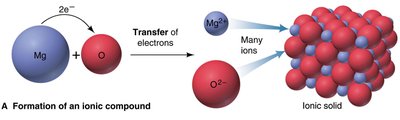
Oxidation: Loss of electrons (increase in oxidation number).
Reduction: Gain of electrons (decrease in oxidation number).
Oxidizing Agent: Causes oxidation by accepting electrons.
Reducing Agent: Causes reduction by donating electrons.
Assigning Oxidation Numbers
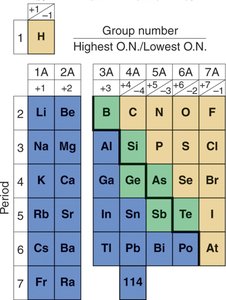
Oxidation numbers are used to keep track of electron transfer in redox reactions. Key rules include:
Elements in their standard state have O.N. = 0.
Monoatomic ions: O.N. = ion charge.
Sum of O.N. in a compound = 0; in a polyatomic ion = ion charge.
Group 1A: +1; Group 2A: +2; Hydrogen: +1 (with nonmetals); Oxygen: -2 (except peroxides); Halogens: usually -1.
Types of Redox Reactions
Combination: Two or more substances form one product.
Decomposition: One substance breaks into two or more products.
Displacement: An element in a compound is replaced by another element.
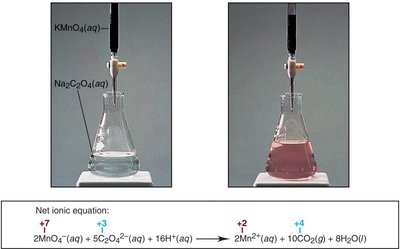
Chemical Equilibrium
Reversible Reactions
Many reactions are reversible, meaning they can proceed in both forward and reverse directions. At equilibrium, the rates of the forward and reverse reactions are equal, and the concentrations of reactants and products remain constant.
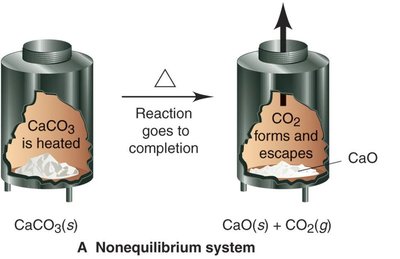
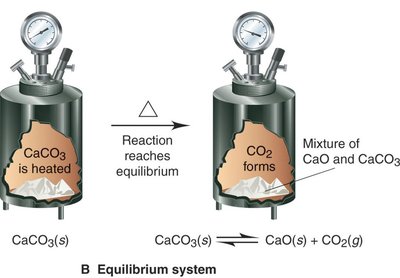
Summary Table: Solubility Rules for Ionic Compounds in Water
Soluble Ionic Compounds | Insoluble Ionic Compounds |
|---|---|
All common compounds of Group 1A(1) ions (Li+, Na+, K+, etc.) and NH4+ | All common metal hydroxides except those of Group 1A(1) and larger Group 2A(2) (starting with Ca2+) |
All common nitrates (NO3−), acetates (CH3COO−), and most perchlorates (ClO4−) | All common carbonates (CO32−) and phosphates (PO43−) except those of Group 1A(1) and NH4+ |
All common chlorides, bromides, and iodides except those of Ag+, Pb2+, Cu+, and Hg22+ | All common sulfides except those of Group 1A(1), Group 2A(2), and NH4+ |
Key Terms and Concepts
Solvent: The substance in which solutes are dissolved to form a solution.
Precipitate: An insoluble solid formed in a chemical reaction in solution.
Electrolyte: A substance that conducts electricity when dissolved in water.
Indicator: A compound that changes color at (or near) the equivalence point in a titration.
Oxidation Number (O.N.): A bookkeeping device to track electron transfer in redox reactions.
Example Equations
Precipitation:
Acid-Base Neutralization:
Redox (Displacement):
Additional info: This summary covers the main types of aqueous reactions, including precipitation, acid-base, and redox reactions, as well as the principles of solubility and chemical equilibrium. It is designed to provide a comprehensive overview for general chemistry students preparing for exams.
