 Back
BackChapter 9: Chemical Bonding I – Lewis Theory and Ionic Bonding
Study Guide - Smart Notes
 Tailored notes based on your materials, expanded with key definitions, examples, and context.
Chapter 9: Chemical Bonding I – Lewis Theory and Ionic Bonding
Introduction to Chemical Bonding
Chemical bonding explains how atoms combine to form compounds. There are three primary types of chemical bonds: ionic, covalent, and metallic. Each type of bond is characterized by the behavior of electrons between atoms.
Ionic Bonding: Involves the transfer of electrons from a metal to a nonmetal, resulting in the formation of oppositely charged ions held together by electrostatic forces.
Covalent Bonding: Involves the sharing of electrons between nonmetal atoms, resulting in the formation of molecules.
Metallic Bonding: Involves metal nuclei floating in a 'sea' of delocalized electrons, characteristic of metallic solids.
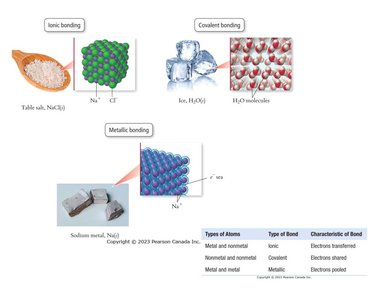
Example: Table salt (NaCl) is an ionic compound, ice (H2O) is a molecular compound with covalent bonds, and sodium metal (Na) exhibits metallic bonding.
Intramolecular vs. Intermolecular Forces
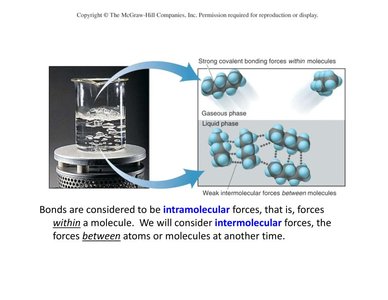
Bonds within a molecule are called intramolecular forces. These are distinct from intermolecular forces, which are the forces between molecules. Intramolecular forces are generally much stronger and determine the chemical identity of a substance.
Physical Properties of Ionic vs. Covalent Compounds
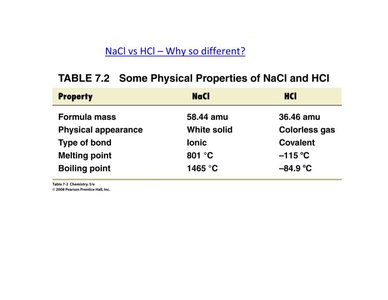
The type of bonding in a compound greatly affects its physical properties. For example, sodium chloride (NaCl) and hydrogen chloride (HCl) have very different properties due to their bonding types.
Property | NaCl | HCl |
|---|---|---|
Formula mass | 58.44 amu | 36.46 amu |
Physical appearance | White solid | Colorless gas |
Type of bond | Ionic | Covalent |
Melting point | 801 °C | –115 °C |
Boiling point | 1465 °C | –84.9 °C |
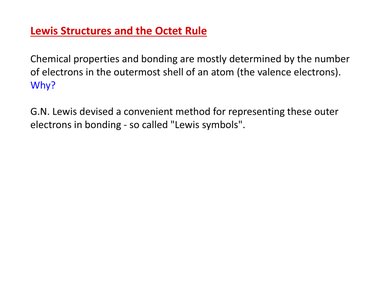
Lewis Structures and the Octet Rule
Writing Lewis Symbols
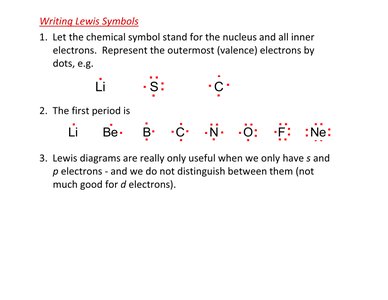
Lewis symbols are a simple way to represent the valence electrons of an atom. The chemical symbol stands for the nucleus and inner electrons, while dots represent the valence electrons.
Each dot corresponds to one valence electron.
Lewis diagrams are most useful for main group elements (s and p block).
Lewis Structures and the Octet Rule
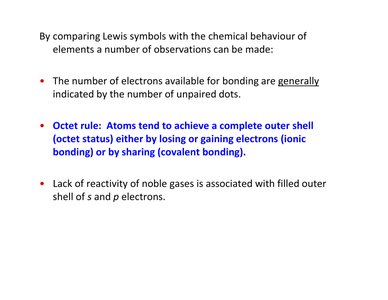
The octet rule states that atoms tend to gain, lose, or share electrons to achieve a full outer shell of eight electrons (except for hydrogen and helium, which seek two). Lewis structures help visualize this process.
Valence electrons determine chemical properties and bonding.
Noble gases are unreactive due to their filled valence shells.
Observations from Lewis Symbols
The number of unpaired dots indicates the number of electrons available for bonding.
Atoms achieve octet status by losing/gaining (ionic) or sharing (covalent) electrons.
Noble gases are stable due to filled s and p subshells.
Ionic Bonding and Lattice Energies
Formation of Ionic Compounds
Ionic compounds form when electrons are transferred from a metal to a nonmetal, resulting in the formation of cations and anions. For example, sodium reacts with chlorine to form sodium chloride:
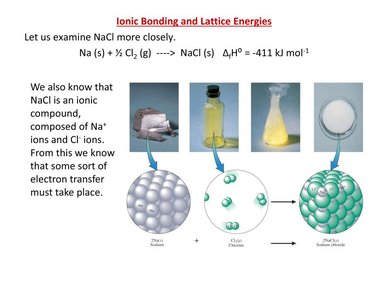
Example: Sodium (Na) loses one electron to become Na+, and chlorine (Cl) gains one electron to become Cl−. The resulting ions are held together by strong electrostatic forces.
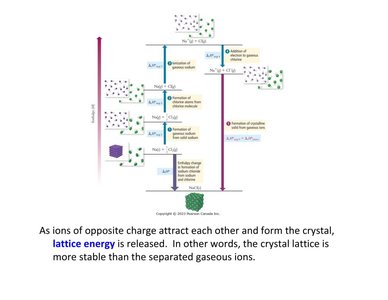
Energetics of Ionic Bond Formation
The formation of ionic bonds involves both endothermic and exothermic steps:
Ionization energy (IE): Energy required to remove an electron from an atom (always positive).
Electron affinity (EA): Energy released when an atom gains an electron (usually negative).
For sodium chloride:
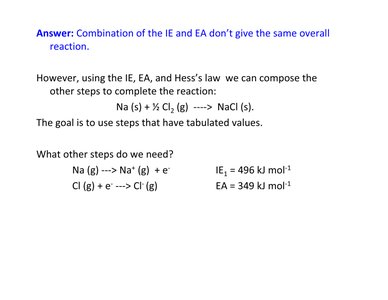
However, the overall reaction is exothermic due to the release of lattice energy when the crystal forms.
Lattice Energy
Lattice energy is the energy released when gaseous ions combine to form an ionic solid. It is always exothermic and is a measure of the stability of the ionic lattice.
Lattice energy depends on the charges of the ions and the distance between them.
Higher charges and smaller ionic radii result in larger (more negative) lattice energies.
Coulomb's Law and Lattice Energy Trends
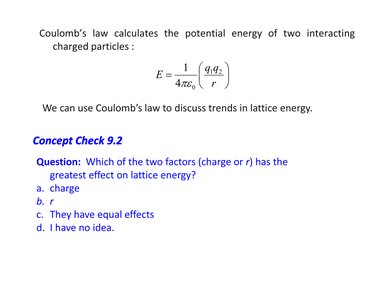
Coulomb's law describes the potential energy between two charged particles:
q1 and q2: Charges of the ions
r: Distance between ion centers
Lattice energy increases with higher ionic charges and decreases with larger ionic radii.
Comparing Lattice Energies
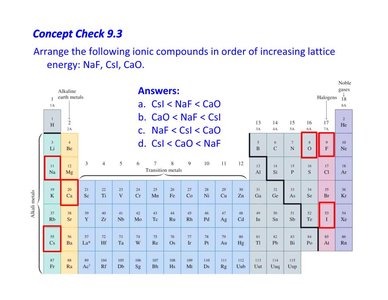
Lattice energies can be compared for different ionic compounds. For example, CaO has a much higher lattice energy than NaF due to the higher charges on Ca2+ and O2− compared to Na+ and F−.
Compound | Lattice Energy (kJ mol−1) |
|---|---|
NaF | –910 |
CaO | –3414 |
Trends:
As ion size increases, lattice energy decreases.
As ion charge increases, lattice energy increases.
Summary Table: Types of Bonds
Types of Atoms | Type of Bond | Characteristic of Bond |
|---|---|---|
Metal and nonmetal | Ionic | Electrons transferred |
Nonmetal and nonmetal | Covalent | Electrons shared |
Metal and metal | Metallic | Electrons pooled |
Additional info: The magnitude of lattice energy is a key factor in determining the melting points, hardness, and solubility of ionic compounds.
