 Back
BackGeneral Chemistry Exam 2 Study Guidance
Study Guide - Smart Notes
 Tailored notes based on your materials, expanded with key definitions, examples, and context.
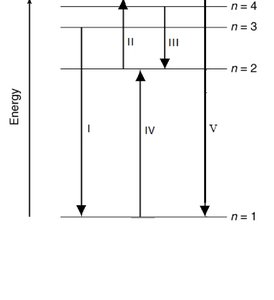
Q2. Which of the transitions or combination of transitions in the following hydrogen atom energy-level diagram results in a net energy change of 0 J?
Background
Topic: Atomic Structure & Electron Transitions
This question tests your understanding of energy changes associated with electron transitions between energy levels in the hydrogen atom. Specifically, it asks you to identify which combination of transitions results in no net energy change (i.e., the total energy absorbed equals the total energy released).
Key Terms and Concepts
Energy Levels (n): Discrete energy states that electrons can occupy in an atom, labeled by the principal quantum number n.
Transition: When an electron moves from one energy level to another, it either absorbs or emits energy equal to the difference between the two levels.
Net Energy Change: The sum of the energy changes for all transitions considered. If the net energy change is zero, the total energy absorbed equals the total energy released.
Direction of Arrow: Upward arrows indicate absorption (energy in), downward arrows indicate emission (energy out).
Step-by-Step Guidance
Examine each labeled transition (I, II, III, IV, V) in the diagram. Note the starting and ending energy levels for each transition.
Recall that moving from a lower to a higher energy level (upward arrow) requires energy absorption, while moving from a higher to a lower energy level (downward arrow) releases energy.
For each transition, determine whether it represents absorption or emission, and the magnitude of the energy change (difference between the two n levels).
Consider combinations of transitions. For a net energy change of zero, the total energy absorbed in upward transitions must equal the total energy released in downward transitions.
Set up an equation or logical check: add the energy changes for the transitions in each combination and see if the sum is zero. You do not need to calculate the exact values, just ensure the upward and downward transitions cancel each other out.
Try solving on your own before revealing the answer!
Final Answer: e. IV, II and V
Transitions IV (up), II (down), and V (down) together result in a net energy change of zero because the energy absorbed in IV is exactly balanced by the energy released in II and V. This is a classic example of how energy conservation applies to electron transitions in atoms.
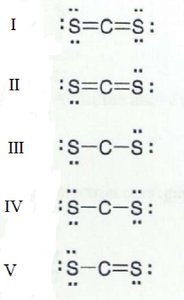
Q15. Choose the Lewis structure that most accurately describes the bonding in CS2.
Background
Topic: Lewis Structures and Resonance
This question tests your ability to determine the most accurate Lewis structure for a molecule, considering formal charges and the octet rule. CS2 (carbon disulfide) is a linear molecule, and the best Lewis structure will minimize formal charges and satisfy the octet rule for each atom.
Key Terms and Concepts
Lewis Structure: A diagram showing the arrangement of valence electrons among atoms in a molecule.
Octet Rule: Atoms tend to form structures in which each atom (except hydrogen) is surrounded by eight electrons.
Formal Charge: Calculated as:
Resonance: Some molecules can be represented by more than one valid Lewis structure.
Step-by-Step Guidance
Count the total number of valence electrons for CS2 (C = 4, S = 6 each).
Draw possible Lewis structures, ensuring all valence electrons are used and each atom has a complete octet where possible.
Calculate the formal charges for each atom in each structure.
Identify the structure(s) with the lowest (ideally zero) formal charges and where the negative charges, if any, are on the more electronegative atom (S).
Check that the structure is consistent with the known linear geometry of CS2.
Try solving on your own before revealing the answer!
Final Answer: b. II
The most accurate Lewis structure for CS2 is the one with double bonds between carbon and each sulfur, giving all atoms a complete octet and minimizing formal charges. This matches structure II in the image.
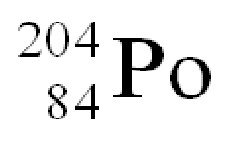
Q35. Which of the following isotopes is definitely unstable?
Background
Topic: Nuclear Chemistry – Isotope Stability
This question tests your understanding of nuclear stability and how to identify unstable isotopes based on their neutron-to-proton ratio and position on the periodic table.
Key Terms and Concepts
Isotope: Atoms of the same element with different numbers of neutrons.
Stability: Stable isotopes have a balanced neutron-to-proton ratio; unstable isotopes (radioactive) do not and will decay.
Magic Numbers: Certain numbers of protons and neutrons confer extra stability.
Heavy Elements: Elements with atomic number > 83 (bismuth) are generally unstable.
Step-by-Step Guidance
Identify the element and its atomic number for each isotope.
Recall that elements with atomic number greater than 83 are always radioactive (unstable).
Compare the neutron-to-proton ratio for each isotope to the band of stability.
Check if the isotope is known to be naturally occurring and stable, or if it is radioactive.
Try solving on your own before revealing the answer!
Final Answer: d. 204/84 Po
Polonium (Po), atomic number 84, is above bismuth (83) and all its isotopes are radioactive. Therefore, 204/84 Po is definitely unstable.
