Ch.1 - Matter, Measurement & Problem Solving
Tro - Chemistry: A Molecular Approach 5th Edition
Tro5th EditionChemistry: A Molecular ApproachISBN: 9780134874371Not the one you use?Change textbook
Chapter 1, Problem 51

Convert each temperature. a. 32 °F to °C (temperature at which water freezes) b. 77 K to °F (temperature of liquid nitrogen) c. -109 °F to °C (temperature of dry ice) d. 98.6 °F to K (body temperature)

Verified step by step guidance
1
To convert from Fahrenheit (°F) to Celsius (°C), use the formula: \( °C = \frac{5}{9} (°F - 32) \).
To convert from Kelvin (K) to Fahrenheit (°F), first convert Kelvin to Celsius using \( °C = K - 273.15 \), then convert Celsius to Fahrenheit using \( °F = \frac{9}{5} °C + 32 \).
To convert from Fahrenheit (°F) to Celsius (°C), use the formula: \( °C = \frac{5}{9} (°F - 32) \).
To convert from Fahrenheit (°F) to Kelvin (K), first convert Fahrenheit to Celsius using \( °C = \frac{5}{9} (°F - 32) \), then convert Celsius to Kelvin using \( K = °C + 273.15 \).

Verified video answer for a similar problem:

This video solution was recommended by our tutors as helpful for the problem above.
Video duration:
1m

Key Concepts

Here are the essential concepts you must grasp in order to answer the question correctly.

Temperature Scales

Temperature can be measured using different scales, primarily Celsius (°C), Fahrenheit (°F), and Kelvin (K). Each scale has its own zero point and degree increments. For example, 0 °C is the freezing point of water, while 32 °F is equivalent to 0 °C. Understanding these scales is essential for converting temperatures accurately.
Recommended video:

Conversion Formulas

To convert temperatures between different scales, specific formulas are used. For instance, to convert Fahrenheit to Celsius, the formula is °C = (°F - 32) × 5/9. Similarly, to convert Kelvin to Celsius, the formula is °C = K - 273.15. Mastery of these formulas is crucial for solving temperature conversion problems.
Recommended video:
Guided course
01:56
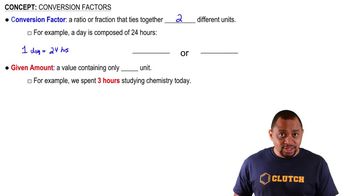
Conversion Factors

Absolute Zero and Temperature Relationships

Kelvin is an absolute temperature scale where 0 K represents absolute zero, the theoretical point where molecular motion ceases. The relationship between Kelvin and Celsius is linear, with 0 °C equal to 273.15 K. Understanding this relationship is important for converting temperatures involving Kelvin, especially in scientific contexts.
Recommended video:
Guided course
03:48
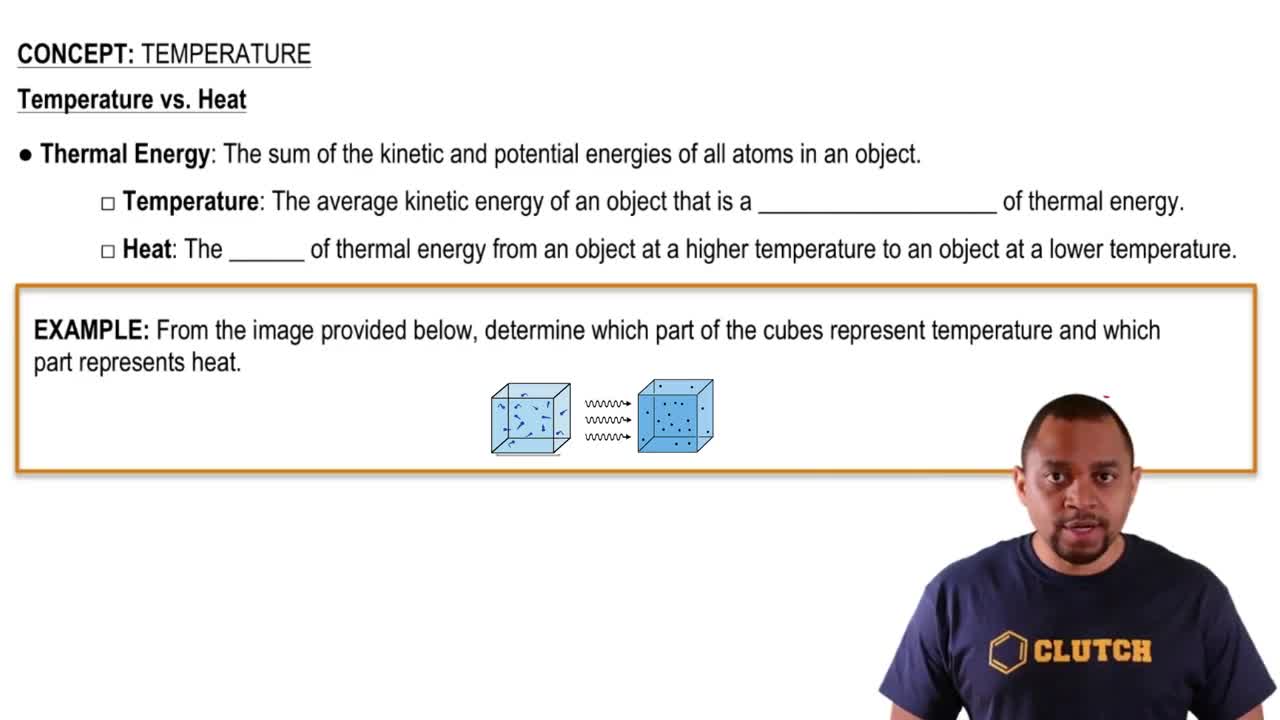
Temperature vs Heat