Ch.3 - Molecules and Compounds
Tro - Chemistry: A Molecular Approach 5th Edition
Tro5th EditionChemistry: A Molecular ApproachISBN: 9780134874371Not the one you use?Change textbook
Chapter 3, Problem 51a

Name each acid. a. HI(aq) b. HNO3(aq) c. H2CO3(aq)

Verified step by step guidance
1
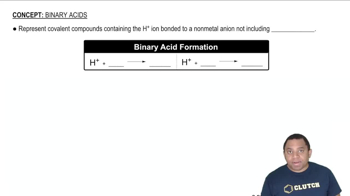
1. Identify the type of acid. In this case, HI(aq) is a binary acid because it consists of two elements: hydrogen and iodine.
2. For binary acids, the name starts with 'hydro-', followed by the root of the nonmetal's name, and ends with '-ic acid'.
3. The nonmetal in this acid is iodine. The root of 'iodine' is 'iod'.
4. Therefore, the name of the acid HI(aq) is 'hydroiodic acid'.

Verified video answer for a similar problem:

This video solution was recommended by our tutors as helpful for the problem above.
Video duration:
2m

Key Concepts

Here are the essential concepts you must grasp in order to answer the question correctly.

Acids and Bases

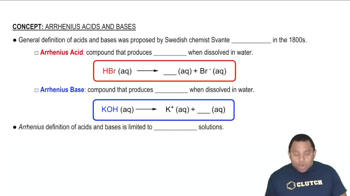
Acids are substances that can donate protons (H+) in a solution, while bases can accept protons. The strength of an acid is determined by its ability to dissociate in water, producing H+ ions. Understanding the properties of acids and bases is fundamental in identifying and naming them.
Recommended video:
Guided course
02:00
Arrhenius Acids and Bases

Strong Acids

Strong acids are those that completely dissociate in water, releasing all of their protons. Hydroiodic acid (HI) is a strong acid, meaning it ionizes fully in aqueous solution. Recognizing strong acids helps in predicting their behavior in chemical reactions and their naming conventions.
Recommended video:
Guided course
01:09
Strong Acid-Strong Base Titration

Nomenclature of Acids

The nomenclature of acids involves specific rules for naming based on their composition. Binary acids, like HI, are named using the prefix 'hydro-' followed by the root of the nonmetal and the suffix '-ic.' This systematic approach is essential for accurately identifying and naming various acids in chemistry.
Recommended video: