Pearson+ LogoPearson+ Logo

Cancer Mutations quiz #1 Flashcards

Back
Cancer Mutations quiz #1
Control buttons has been changed to "navigation" mode.
1/10
  • What is a tumor suppressor gene and what role does it play in cancer development?

    A tumor suppressor gene is a gene whose normal function is to inhibit cell division and suppress tumor growth. When mutated, tumor suppressor genes lose their ability to control cell proliferation, allowing abnormal growth and contributing to cancer development. Examples include the retinoblastoma gene and p53.
  • What distinguishes a driver mutation from a passenger mutation in cancer cells?

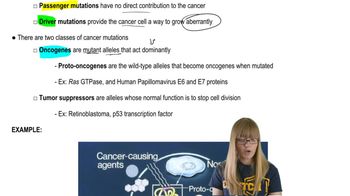
    Driver mutations actively contribute to cancer development by promoting abnormal growth or survival. Passenger mutations do not affect cancer progression and are simply present due to accumulated DNA damage.
  • How does a proto-oncogene become an oncogene?

    A proto-oncogene becomes an oncogene when it acquires a mutation that causes it to act dominantly and promote cancerous phenotypes. This mutated form drives abnormal cell growth and proliferation.
  • What is the role of Ras GTPase in cancer as mentioned in the transcript?

    Ras GTPase is an example of an oncogene involved in signal transduction pathways. When mutated, it can promote cancer by driving abnormal cell signaling and growth.
  • Why are transcription factors like p53 and retinoblastoma significant in cancer genetics?

    Transcription factors such as p53 and retinoblastoma regulate the expression of many genes. Mutations in these factors can disrupt the normal regulation of multiple genes, leading to widespread effects on cell function and cancer development.
  • How do mutations in p53 affect gene expression in cancer cells?

    Mutations in p53 alter the expression of all genes it regulates, causing them to be overexpressed or underexpressed. This widespread misregulation contributes to the cancer phenotype.
  • What is unique about the inheritance pattern of retinoblastoma mutations compared to p53 mutations?

    Retinoblastoma mutations can be inherited and often act as recessive alleles, requiring both copies to be mutated for cancer to develop. In contrast, p53 mutations are typically acquired in somatic cells and are not inherited.
  • Why is understanding the difference between oncogenes and tumor suppressors emphasized in cancer genetics education?

    The distinction is crucial because oncogenes promote cancer when activated, while tumor suppressors prevent cancer when functioning normally. This fundamental difference is commonly tested in exams on cancer genetics.
  • What happens when both copies of the retinoblastoma gene are mutated?

    When both copies of the retinoblastoma gene are mutated, the cell loses its ability to suppress tumor formation. This leads to the development of retinoblastoma, a type of eye cancer in children.
  • How do cancer-causing agents contribute to the activation of proto-oncogenes?

    Cancer-causing agents induce mutations in proto-oncogenes, converting them into oncogenes. This activation, along with other accumulated mutations, leads to cancer development.