Skip to main content
Genetics
My Course
Learn
Exam Prep
AI Tutor
Study Guides
Textbook Solutions
Flashcards
Explore
Try the app
My Course
Learn
Exam Prep
AI Tutor
Study Guides
Textbook Solutions
Flashcards
Explore
Try the app
Back
Chromosomal Mutations: Aneuploidy quiz #1
You can tap to flip the card.
What chromosomal abnormalities are caused by nondisjunction?
You can tap to flip the card.
👆
What chromosomal abnormalities are caused by nondisjunction?
Nondisjunction causes aneuploidy, such as trisomy (2n+1) and monosomy (2n-1), by failing to separate chromosomes properly during cell division.
Track progress
Control buttons has been changed to "navigation" mode.
1/16
Related flashcards
Related practice
Recommended videos
Chromosomal Mutations: Aneuploidy definitions
Chromosomal Mutations: Aneuploidy
15 Terms
Chromosomal Mutations: Aneuploidy
6. Chromosomal Variation
7 problems
Topic
Kylia
Chromosomal Rearrangements: Overview
6. Chromosomal Variation
1 problem
Topic
Kylia
6. Chromosomal Variation - Part 1 of 2
5 topics
10 problems
Chapter
Kylia
6. Chromosomal Variation - Part 2 of 2
3 topics
10 problems
Chapter
Kylia
Guided course
09:05
Aneuploidy
1982
views
16
rank
1
comments
Terms in this set (16)
Hide definitions
What chromosomal abnormalities are caused by nondisjunction?
Nondisjunction causes aneuploidy, such as trisomy (2n+1) and monosomy (2n-1), by failing to separate chromosomes properly during cell division.
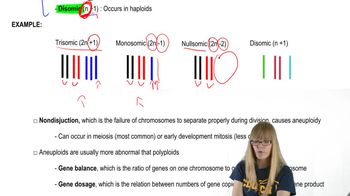
What are some types of aneuploidy?
Trisomic (2n+1), monosomic (2n-1), and nolesomic (2n-2) are considered types of aneuploidy.
What type of mutations affect the whole chromosome number?
Aneuploidy mutations affect the number of individual chromosomes, while aberrant euploidy affects the entire set of chromosomes.
What kind of chromosomal mutation occurred in the sex chromosome of an individual with the genotype XXY?
A trisomic aneuploidy occurred, specifically an extra X chromosome, as seen in Klinefelter's syndrome.
What condition results in chromosome numbers of 2n+1 or 2n-1?
Aneuploidy, specifically trisomy (2n+1) or monosomy (2n-1), results in these chromosome numbers.
What are examples of aneuploidy in an organism with 2n = 20?
Examples include 2n+1 = 21 (trisomic) and 2n-1 = 19 (monosomic).
What genetic condition can result in a human zygote with 45 chromosomes?
Monosomy, such as Turner syndrome (missing one sex chromosome), can result in a human zygote with 45 chromosomes.
What meiotic error can produce a human zygote with 45 chromosomes?
Nondisjunction during meiosis can produce gametes that lead to a zygote with 45 chromosomes.
What is the term for a chromosome number that is either 2n + 1 or 2n - 1?
Aneuploidy, specifically trisomy (2n+1) or monosomy (2n-1), describes this situation.
If nondisjunction occurs and an individual survives, what chromosomal condition might they have?
They may have aneuploidy, such as trisomy (e.g., Down syndrome) or monosomy (e.g., Turner syndrome).
Why do some people have unusual chromosome combinations?
Unusual chromosome combinations often result from nondisjunction, leading to aneuploidy.
Of the following chromosomal abnormalities, which type is most likely to be viable in humans?
Trisomy, such as Down syndrome (trisomy 21), is the most likely to be viable in humans.
The most common extra-chromosome condition is _____.
Down syndrome (trisomy 21) is the most common extra-chromosome condition.
A(n) ________ individual has a change in the correct number of an individual chromosome.
Aneuploid individual has a change in the correct number of an individual chromosome.
A gamete is aneuploid if __________.
A gamete is aneuploid if it has an abnormal number of chromosomes due to nondisjunction.
Nondisjunction might result in gametes with the chromosome numbers ________.
Nondisjunction might result in gametes with chromosome numbers n+1 or n-1.
 BackBack
 09:05
09:05