What is a chromosomal rearrangement that affects an entire chromosome, and what are some examples of such mutations?
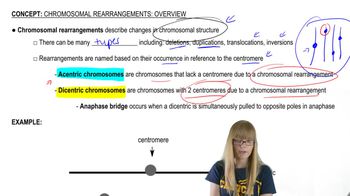
A chromosomal rearrangement that affects an entire chromosome involves structural changes such as deletions, duplications, inversions, or translocations. These mutations can result in chromosomes lacking a centromere (acentric chromosomes) or having two centromeres (dicentric chromosomes), and can be classified as unbalanced (changing gene dosage) or balanced (changing gene order without altering gene dosage).
How are chromosomal rearrangements typically named in relation to the centromere?
Chromosomal rearrangements are named based on their occurrence relative to the centromere's position. The centromere can be located anywhere on the chromosome, affecting the naming of the rearrangement.
What structural change leads to the formation of an acentric chromosome?
An acentric chromosome is formed when a chromosomal rearrangement causes the chromosome to lose its centromere. This loss can result from deletions or other structural changes.
What is the consequence of having two centromeres on a chromosome during cell division?
A chromosome with two centromeres, called dicentric, can be pulled in opposite directions during anaphase, creating an anaphase bridge. This can lead to the chromosome being ripped apart.
What is an anaphase bridge and how does it occur?
An anaphase bridge occurs when a dicentric chromosome is pulled toward opposite poles during anaphase. Microtubules attach to both centromeres and pull the chromosome apart.
What distinguishes a balanced chromosomal rearrangement from an unbalanced one?
A balanced rearrangement changes the gene order without altering gene dosage. In contrast, an unbalanced rearrangement changes gene dosage by deleting or duplicating genes.
Which types of chromosomal rearrangements are considered balanced?
Inversions and translocations are considered balanced rearrangements. They alter the order of genes but do not change the total number of genes present.
What happens to gene dosage in an unbalanced chromosomal rearrangement?
Gene dosage changes in an unbalanced rearrangement due to the deletion or duplication of genes. This results in either a loss or gain of genetic material.
How do microtubules interact with centromeres during chromosome separation in cell division?
Microtubules attach to centromeres and pull chromosomes to opposite poles during cell division. This process ensures proper segregation of chromosomes into daughter cells.
What is the effect of a chromosomal inversion on gene order and dosage?
A chromosomal inversion changes the order of genes but does not affect gene dosage. The total number of genes remains the same, only their sequence is altered.