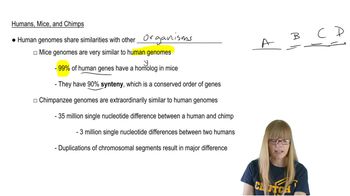
Approximately what percentage of DNA do humans and chimpanzees share according to comparative genomics studies?
Humans and chimpanzees share an extremely high percentage of their DNA, with their genomes being extraordinarily similar. The main differences are about 35 million single nucleotide differences and some chromosomal segment duplications, but overall, the DNA similarity is estimated to be around 98–99%.
What is the definition of a homolog in comparative genomics?
A homolog is a gene with a similar DNA sequence and evolutionary origin found in different organisms. Homologs arise from a common ancestral gene.
How do orthologs differ from paralogs in terms of their evolutionary origin and location?
Orthologs are genes in different organisms that originated from a common ancestor. Paralogs are genes within the same organism that arose from gene duplication.
What principle do evolutionary biologists use to infer the simplest evolutionary pathway when studying phylogeny?
They use the principle of parsimony to choose the simplest explanation for evolutionary relationships. Parsimony helps determine the most likely origin of genes or traits.
Why do platypuses possess yolk genes while most other mammals do not?
Platypuses retained yolk genes from a common egg-laying ancestor, while other mammals lost these genes over time. This supports the idea of a shared evolutionary origin for egg-laying genes.
What does synteny refer to in the context of comparative genomics?
Synteny describes the conserved order of genes between different organisms. High synteny indicates that gene sequences are arranged similarly across species.
Approximately what percentage of human genes have homologs in mice?
About 99% of human genes have homologs in mice. This highlights the close genetic relationship between the two species.
How many single nucleotide differences are there between human and chimpanzee genomes?
There are about 35 million single nucleotide differences between human and chimpanzee genomes. This number is only about ten times greater than the differences between two individual humans.
What is a major genomic difference between humans and chimpanzees besides single nucleotide changes?
A major difference is the duplication of chromosomal segments, with humans having more duplications in certain regions than chimpanzees. This contributes to genomic variation between the species.
Why is comparative genomics useful for understanding evolutionary relationships among organisms?
Comparative genomics allows scientists to trace gene origins and evolutionary history by comparing DNA sequences and gene arrangements. It helps reveal how genomes have evolved and diversified across species.