Skip to main content
Genetics
My Course
Learn
Exam Prep
AI Tutor
Study Guides
Textbook Solutions
Flashcards
Explore
Try the app
My Course
Learn
Exam Prep
AI Tutor
Study Guides
Textbook Solutions
Flashcards
Explore
Try the app
Back
Discovery of Transposable Elements definitions
You can tap to flip the card.
Transposable Element
You can tap to flip the card.
👆
Transposable Element
A small DNA segment capable of moving to different genomic locations, altering gene function and phenotype.
Track progress
Control buttons has been changed to "navigation" mode.
1/15
Related flashcards
Related practice
Recommended videos
Discovery of Transposable Elements quiz #1
Discovery of Transposable Elements
10 Terms
Discovery of Transposable Elements
16. Transposable Elements
4 problems
Topic
Kylia
Transposable Elements in Prokaryotes
16. Transposable Elements
3 problems
Topic
Nicole
16. Transposable Elements
4 topics
8 problems
Chapter
Kylia
Guided course
07:18
Discovery
1197
views
11
rank
3
comments
Terms in this set (15)
Hide definitions
Transposable Element
A small DNA segment capable of moving to different genomic locations, altering gene function and phenotype.
Barbara McClintock
A pioneering scientist who revealed the existence and behavior of mobile DNA segments in maize.
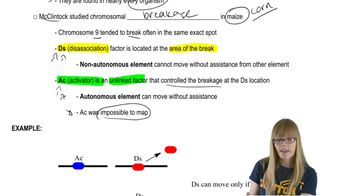
Chromosomal Breakage
A recurring event in maize chromosome 9, leading to the discovery of mobile DNA segments.
Maize
A plant model, also known as corn, used to uncover the movement of DNA segments within chromosomes.
Dissociation Factor
A non-autonomous DNA segment requiring another element to move and disrupt gene function.
Activator Factor
An autonomous DNA segment that enables its own movement and stimulates other elements to relocate.
Non-autonomous Element
A DNA segment unable to move independently, relying on another factor for mobility.
Autonomous Element
A DNA segment capable of relocating within the genome without external assistance.
Genome
The complete set of genetic material in an organism, hosting both mobile and stationary DNA segments.
Phenotype
The observable traits, such as kernel color, resulting from genetic and environmental influences.
Unstable Phenotype
A variable trait pattern, like spotted corn kernels, caused by dynamic DNA segment movement.
Color Gene
A genetic region in maize whose disruption by mobile DNA segments leads to changes in kernel appearance.
Recombination Frequency
A measure of genetic element movement, complicated by mobile DNA segments changing positions.
Genetic Variability
The diversity in genetic makeup, enhanced by the movement of DNA segments within the genome.
Evolution
A process influenced by mobile DNA segments, contributing to changes in genetic traits over generations.
 BackBack

 07:18
07:18