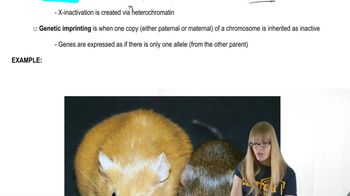
Genetic imprinting, where genes from one parent are silenced and only the other parent's genes are expressed, is an example of epigenetic inheritance.
What is a false statement about epigenetics?
A false statement about epigenetics is: 'Epigenetic modifications permanently change the DNA sequence.' Epigenetic changes alter gene expression without changing the DNA sequence.
How do epigenetic marks compare in monozygotic twins?
Monozygotic twins start with similar epigenetic marks, but these can diverge over time due to environmental influences, leading to differences in gene expression.
What molecular modifications are most closely associated with the idea of epigenetics?
Chromatin modifications, such as histone acetylation and methylation, are most closely associated with the idea of epigenetics.
Heterochromatin is not transcribed because ______.
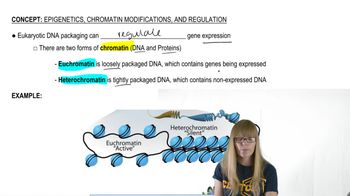
Heterochromatin is not transcribed because it is tightly packaged, preventing transcription factors and RNA polymerase from accessing the DNA.
What is the role of the SWISNF complex in chromatin remodeling?
The SWISNF complex is a protein complex that repositions nucleosomes to expose or hide DNA regions, such as promoters, thereby regulating gene expression.
How do histone deacetylases affect chromatin structure and gene expression?
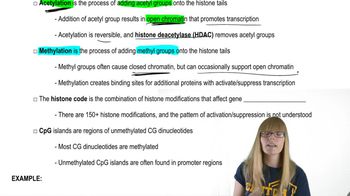
Histone deacetylases remove acetyl groups from histone tails, leading to closed chromatin and repression of gene transcription.
What are CpG islands and where are they commonly found?
CpG islands are regions of unmethylated CG dinucleotides, and they are commonly found in promoter regions of genes.
Why are histone variants considered important in gene regulation?
Histone variants are rare forms of histone proteins found in unique chromosomal regions, such as the centromere, and may influence chromatin structure and gene regulation.
What is the histone code and why is it significant in genetics?
The histone code refers to the complex combination of over 150 types of histone modifications that collectively determine whether genes are activated or suppressed, but its full meaning is not yet understood.
How does histone acetylation affect gene expression?
Histone acetylation adds acetyl groups to histone protein tails, resulting in open chromatin structure. This open chromatin allows transcription factors and RNA polymerase to access DNA, thereby promoting gene expression.
What effect does methylation have on DNA and gene expression?
Methylation, typically the addition of methyl groups to histone tails or DNA, usually leads to closed chromatin structure, which suppresses gene expression. However, in some cases, methylation can result in open chromatin and activate gene expression, depending on the context and proteins involved.
Which functional groups are commonly added to histone proteins to affect gene expression?
The most common functional groups added to histone proteins that affect gene expression are acetyl groups (acetylation) and methyl groups (methylation). Other modifications include phosphorylation and ubiquitination.
How do histone modifications alter gene expression?
Histone modifications, such as acetylation and methylation, change how tightly DNA is packaged around histones. Acetylation generally opens chromatin and promotes gene expression, while methylation usually closes chromatin and suppresses gene expression. The combination of these modifications, known as the histone code, determines whether genes are activated or silenced.
How does acetylation of histone proteins influence chromatin structure and transcription?
Acetylation of histone proteins leads to a more open chromatin structure, making DNA accessible to transcription machinery and thereby promoting transcription and gene expression.
 Back
Back
 02:51
02:51